How Horizontal Orbital Stretch Wrappers Enhance Logistics Operations in the USA?
As a packing machine engineer who built a successful factory from scratch, I've seen firsthand how logistics bottlenecks can cripple operations. Many warehouses across the United States struggle with inefficient packaging processes that delay shipments and increase costs. The pressure to maintain smooth logistics operations while controlling expenses keeps many managers awake at night.
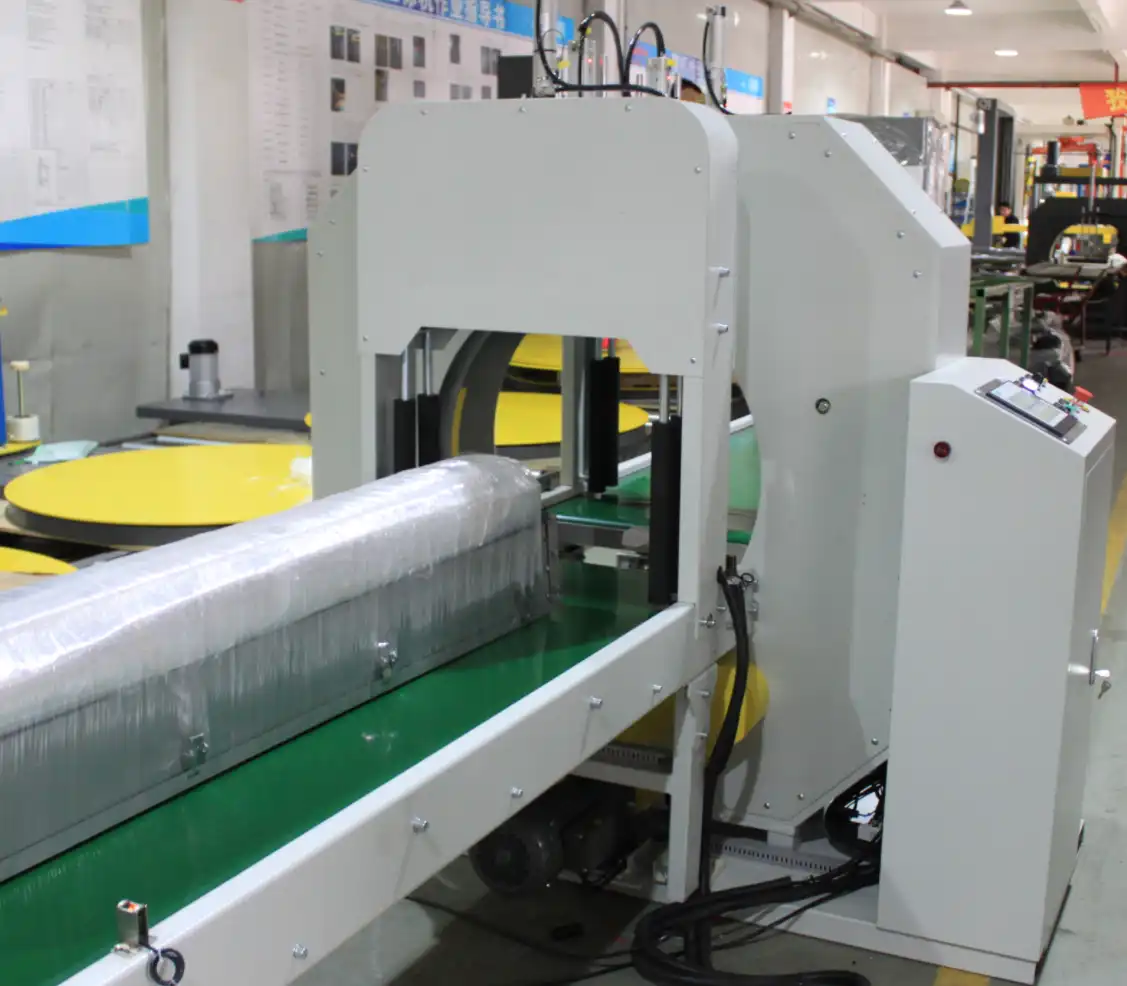
Horizontal orbital stretch wrappers revolutionize American logistics by automating the packaging of long, heavy items like pipes, steel coils, and lumber, significantly reducing labor costs, minimizing product damage, and accelerating throughput. These machines create secure, weather-resistant loads that survive rough transportation, making them ideal for the demanding North American supply chain. Companies using this technology report 40-60% faster packaging times and 30% reduction in material costs compared to manual methods.


The transformation happening in American warehouses deserves closer examination. Let's explore how this technology specifically addresses the unique challenges faced by logistics operations across different industries in the United States.
1. How Do Horizontal Orbital Wrappers Solve Specific American Logistics Challenges?
American logistics faces unique pressures - vast distances, tight delivery schedules, and high labor costs. These factors create specific packaging challenges that conventional methods struggle to address efficiently. Many warehouses experience costly delays when packaging irregularly shaped items for cross-country shipments.
Horizontal orbital wrappers directly tackle America's distinct logistics problems by providing rapid, consistent packaging for difficult-to-wrap items, reducing dependence on scarce manual labor while ensuring loads survive extended transit times. This technology proves particularly valuable for industries shipping long products like construction materials, metal profiles, and automotive components across the country's extensive transportation networks.


🏭 Addressing Core American Logistics Pain Points
| Challenge | Traditional Method | Horizontal Orbital Solution |
|---|---|---|
| Labor Shortages | 3-4 workers needed | 1 operator manages entire process |
| Long-Distance Damage | Additional padding & bracing | Uniform tension protects entire length |
| Irregular Shapes | Time-consuming custom crating | Consistent wrap regardless of profile |
| Weather Exposure | Waterproof covers & tarps | Stretch film creates moisture barrier |
| Throughput Demands | Limited by human endurance | Continuous operation possible |
The American manufacturing resurgence demands packaging solutions that keep pace with production. Horizontal orbital technology enables warehouses to:
- Handle labor market fluctuations - With fewer skilled workers available, automation becomes essential
- Meet just-in-time delivery requirements - Faster packaging prevents bottlenecks in tight schedules
- Reduce transportation claims - Properly wrapped loads arrive intact despite rough handling
- Comply with safety regulations - Automated systems minimize worker interaction with heavy items
Companies like Fengding and Wuxi Buhui have developed models specifically designed for American warehouse layouts and operational requirements. Their machines accommodate standard American pallet sizes and integrate smoothly with existing conveyor systems. (American logistics packaging solutions)
2. What Operational Benefits Do US Companies Actually Achieve?
Many logistics managers hesitate to invest in new equipment without clear evidence of tangible returns. They need concrete numbers to justify capital expenditures to corporate leadership, especially when competing for limited budget allocations.
US companies implementing horizontal orbital wrappers typically achieve 50-70% reduction in packaging labor costs, 45% faster processing times, and 90% decrease in product damage during transit. These measurable improvements directly impact bottom-line profitability while enhancing customer satisfaction through reliable delivery of undamaged goods.


📊 Quantifiable Performance Metrics
The transformation extends beyond theoretical benefits to documented financial impact:
Labor Cost Reduction
- Pre-automation: 3 workers × $25/hour × 8 hours = $600 daily
- Post-automation: 1 operator × $30/hour × 8 hours = $240 daily
- Daily savings: $360 | Monthly: $7,200 | Annual: $86,400
Throughput Acceleration
- Manual wrapping: 15-20 minutes per load
- Automated orbital wrapping: 5-7 minutes per load
- Capacity increase: 200-300%
Damage Cost Elimination
- Previous damage rate: 3-5% of shipped value
- Post-implementation: 0.5-1% of shipped value
- Typical annual savings: $15,000-$45,000
Beyond these direct financial benefits, companies report significant indirect advantages:
- Reduced workers' compensation claims from eliminating heavy lifting
- Lower film consumption through optimized tension control
- Decreased warehouse space requirements with faster turnaround
- Enhanced shipping flexibility to meet urgent customer requests
The ROI calculation becomes compelling - most American operations recover their equipment investment within 12-18 months through these combined savings. (operational benefits of stretch wrapping)
3. Which Industries Benefit Most from This Technology in the American Market?
Not all businesses experience equal benefits from horizontal orbital wrapping technology. Understanding which sectors gain the most advantage helps managers assess whether their operation fits the ideal profile for this automation solution.
Construction materials, metal manufacturing, automotive components, and lumber industries derive the greatest benefits from horizontal orbital wrappers in the US market due to their handling of long, heavy products that challenge conventional packaging methods. These sectors face particular pressure from tight margins, demanding customers, and complex supply chains where packaging efficiency directly impacts competitiveness.

🏗️ Sector-Specific Applications and Advantages
Construction Materials Suppliers
- Products: Steel rebar, construction profiles, scaffolding pipes
- Challenges: Sharp edges damage film, variable lengths, outdoor storage
- Solutions: Heavy-duty film options, adjustable programming, weather resistance
- Vendor Note: Fengding offers reinforced film systems specifically for construction applications
Metal Service Centers
- Products: Aluminum extrusions, structural steel, metal coils
- Challenges: High-value products, cosmetic sensitivity, just-in-time demands
- Solutions: Non-marking rollers, tension control, rapid changeover
- Vendor Note: Wuxi Buhui provides non-marking contact points for finished metals
Automotive Component Manufacturers
- Products: Chassis frames, exhaust systems, roll cages
- Challenges: Complex geometries, zero-defect expectations, sequencing requirements
- Solutions: Programmable patterns, barcode integration, quality verification
- Implementation Tip: Start with highest-volume parts for quickest ROI
Lumber and Building Products
- Products: Dimensional lumber, trim materials, composite decking
- Challenges: Weight variations, moisture protection, bundle integrity
- Solutions: Compression options, vented film patterns, UV protection
- Regional Consideration: Different film types needed for various US climates
The technology demonstrates particular value for American businesses shipping products longer than 8 feet - dimensions that make manual wrapping impractical and conventional machines ineffective. Companies processing between 20-200 loads daily typically achieve the strongest financial returns. (industrial packaging applications USA)
4. How Does This Technology Integrate with Existing US Warehouse Operations?
Managers rightly worry about disruption during technology implementation. They need assurance that new equipment will complement rather than complicate their established workflows, especially in facilities where space is already optimized and processes finely tuned.
Horizontal orbital wrappers integrate smoothly with American warehouse operations through standardized interfaces, modular designs, and flexible configurations that adapt to existing material flow patterns without major facility modifications. Successful implementation typically requires just 2-3 days of installation with minimal disruption to ongoing activities.
🔄 Implementation Process and Considerations
Space Requirements and Layout Options
- Footprint: Typically 20-30 feet of linear conveyor space
- Clearance: 12-15 feet height for full rotation capability
- Layout Options:
- In-line with existing conveyor systems
- Right-angle transfer configurations
- Stand-alone with feed and discharge conveyors
Integration Timeframe and Steps
- Week 1: Site assessment and foundation preparation
- Week 2: Equipment delivery and mechanical installation
- Week 3: Electrical connection and control system programming
- Week 4: Operator training and production testing
Staff Training and Transition
- Machine Operators: 2-3 days hands-on training
- Maintenance Team: 1-day technical overview
- Supervisors: Half-day operational parameters session
American facilities typically choose between three integration approaches:
- Basic Implementation: Standalone machine with manual load positioning
- Intermediate Solution: Integrated with existing conveyor with manual film attachment
- Advanced Automation: Fully automated with robotic load handling and film cutting
The most successful implementations begin with a thorough analysis of current packaging workflow, identifying specific bottleneck points where the technology will deliver maximum impact. Companies should document current packaging times, labor requirements, and damage rates before implementation to accurately measure improvement. (warehouse automation integration)
My Insights!
Having worked with dozens of American manufacturers and logistics providers, I've observed that the most successful implementations share common characteristics. They begin with clear objectives, involve operations staff in equipment selection, and phase implementation to build confidence. The companies achieving the fastest ROI typically start by addressing their most problematic packaging application first, rather than attempting complete transformation immediately.
The American market presents unique opportunities for horizontal orbital wrapping technology. The combination of long supply chains, high labor costs, and demanding customers creates perfect conditions for this automation solution to deliver exceptional value. Based on my experience helping companies like Michael's metal processing facility, I've found that the partnership approach - where supplier and customer collaboratively solve problems - yields far better results than simple equipment transactions.
Conclusion
Horizontal orbital stretch wrappers transform American logistics by automating difficult packaging tasks, reducing costs, and improving shipment reliability. This technology delivers measurable ROI while addressing specific challenges faced by US industries. Consider how an Orbital Stretch Wrapper could optimize your operation.
Related posts: