Reducing Film Waste with Precision Orbital Stretch Wrapper Settings?
Leading paragraph:
Every day in factories like yours, money is literally thrown in the trash. It's not coins or bills, but something just as valuable: stretch film. As a packing machine engineer who has built a factory from the ground up, I've walked countless production floors. I've seen the frustration on managers' faces when they review monthly expenses and see the shocking cost of film waste. This waste is a silent profit killer, often accepted as just "the cost of doing business." But what if I told you that the key to stopping this financial drain is not in buying more film, but in mastering the settings on a machine you might already own? The precision of your orbital stretch wrapper's settings is the single most powerful tool you have to cut costs and boost efficiency right now.
Snippet paragraph:
Yes, you can significantly reduce film waste by mastering the precision settings on your orbital stretch wrapper. The core principle is to use the exact amount of film needed for a secure load, and no more. This is achieved by fine-tuning key parameters like film force (tension), overlap, pre-stretch percentage, and wrap count. An optimally configured machine eliminates excessive, loose, or uneven film application, directly translating to lower material costs, reduced environmental impact, and more consistent, secure pallets. (orbital stretch wrapper film savings, precision stretch wrapping settings)


Transition Paragraph:
You might think your wrapper is running fine, but small, unoptimized settings can lead to big losses over time. This isn't just about pressing a few buttons. It's about understanding the science behind the stretch and applying it to your specific products—whether you're securing heavy steel coils or bundles of wire rod. Let's break down the exact settings you need to control and how each one contributes to a leaner, more cost-effective packaging line.
1. What are the Core Machine Settings That Directly Control Film Usage?
Leading paragraph:
Imagine driving a car with the gas pedal stuck halfway down. No matter if you're on a highway or in a parking lot, you're wasting fuel. Your orbital wrapper can act the same way if its core settings are not matched to the load. Using generic, "one-size-fits-all" presets is a guaranteed way to waste film. To take control, you must first understand the dashboard of your machine.
Snippet paragraph:
The four core machine settings that directly control film usage are Film Tension (Force), Pre-Stretch Ratio, Overlap Percentage, and Wrap Count. Think of them as the fundamental levers for material efficiency. Adjusting these settings in harmony ensures the film is applied with optimal strength and economy, preventing both overuse and underwrapping that leads to load failure. (stretch wrapper film tension control, pre-stretch ratio optimization)


🎯 The Four Control Levers for Film Efficiency
Let's dive deeper into each setting. Getting these right is the foundation of waste reduction.
| Setting | What It Does | Impact on Film Waste | Ideal Adjustment Goal |
|---|---|---|---|
| Film Tension (Force) | Controls how tightly the film is pulled during wrapping. | Too High: Film can break or over-stress, risking tears. May use more film due to breaks. Too Low: Loose, baggy wraps require more layers for stability, wasting film. |
Find the highest tension that doesn't cause consistent film breaks for your load type. |
| Pre-Stretch Ratio | Mechanically stretches the film before it touches the load (e.g., 250%). | Too Low: Film isn't fully activated, requiring more wraps for strength. Too High: Film can become weak and prone to tearing, needing overlap for safety. |
Match to the film's specification. For most pallets, 200%-250% is efficient. |
| Overlap Percentage | Determines how much each film spiral covers the previous one. | Too High: Excessive overlap uses far more film than necessary. Too Low: Gaps can compromise load integrity, leading to product damage and returns. |
Typically 50% is standard. For very unstable loads, 60-70%. For uniform loads, 40-50% may suffice. |
| Wrap Count | The total number of film layers applied around the load. | Too High: The most direct source of waste—adding unnecessary layers. Too Low: Load becomes unstable, risking collapse and massive product loss. |
Start with manufacturer guidelines, then test downward. Often 4-6 rotations at the top and bottom are sufficient. |
The critical insight here is that these settings interact. A higher pre-stretch might allow you to reduce the wrap count. A perfect overlap means you might not need extreme tension. You cannot adjust one in isolation. The goal is to find the sweet spot combination where all four work together to create a secure unit load with the minimum grams of film. I always advise my clients, like factory managers in Mexico's heavy industry, to conduct "film audits." Run 10 pallets with your current settings and weigh the film used. Then, make one precise adjustment (like reducing overlap by 10%) and run 10 more. The scale doesn't lie, and this data-driven approach reveals your true waste—and your savings potential. (optimizing orbital wrapper parameters, stretch film consumption audit)
2. How Do You Calibrate Settings for Different Load Types (Like Steel Coils vs. Wire Rod)?
Leading paragraph:
Wrapping a perfect cube-shaped pallet of boxes is one thing. Wrapping a heavy, cylindrical steel coil or a long, dense bundle of wire rod is a completely different challenge. Using the same settings for both is like using a hammer to screw in a lightbulb—it might eventually work, but the process is wasteful and dangerous. Your machine must be as adaptable as your product line.
Snippet paragraph:
Calibrating for different loads requires a strategy based on load shape, weight, and surface friction. For dense, heavy items like steel coils, you need high tension and focus on securing the core. For long, multiple items like wire rod bundles, you need consistent tension and extra focus on locking the ends together. The process involves creating and saving specific "recipes" or programs in your wrapper's control system for each major product type. (stretch wrapping steel coils, wire rod bundle packaging)
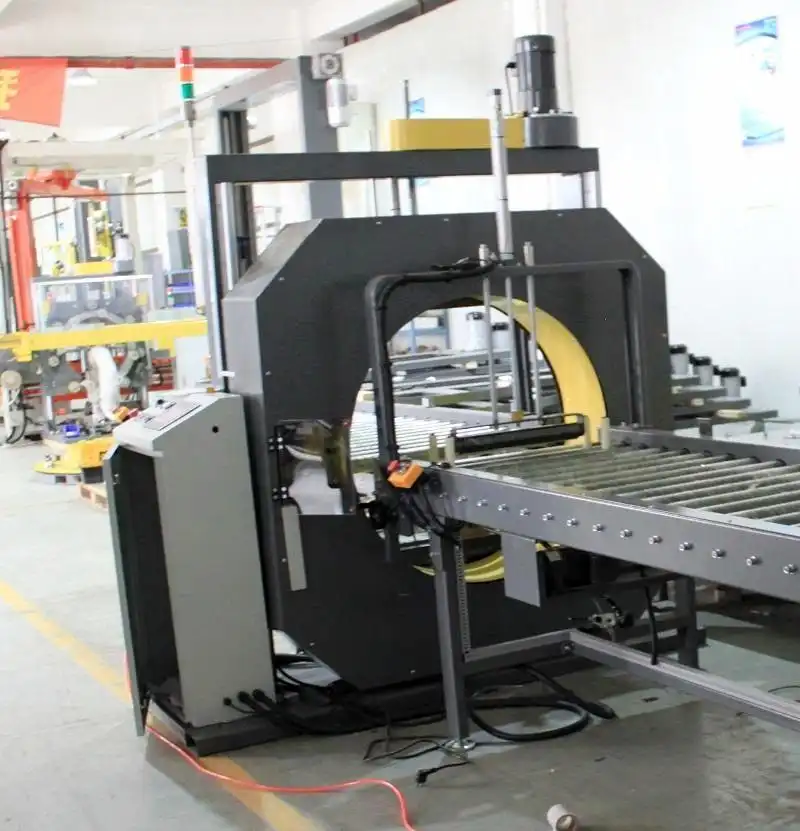

A Step-by-Step Calibration Guide for Heavy Industrial Loads
Here is a practical framework I've developed for calibrating orbital wrappers in metal processing plants. Follow this to build your load-specific programs.
Step 1: Load Analysis & Categorization
- Group A (Heavy Single Unit): e.g., Large Steel Coils.
- Challenge: Immense weight, curved surface, risk of edge damage.
- Calibration Focus: Maximum film force (tension) to prevent film recoil. High wrap count at the very top and bottom edges to "lock" the coil onto the pallet. A lower overlap (40-50%) can be sufficient because the surface is continuous.
- Group B (Multiple Unit Bundles): e.g., Wire Rod, Rebar, Pipe Bundles.
- Challenge: Items can shift, sharp edges can puncture film, load needs to be unified.
- Calibration Focus: Moderate to high tension. Crucially, a higher overlap (60-70%) is needed to bridge gaps between individual rods and prevent film from slipping into the spaces. Extra wraps are needed along the entire length to create compression force that binds the bundle as one.
Step 2: The "Test and Observe" Protocol
- Start with a conservative baseline program (medium tension, 250% pre-stretch, 50% overlap, 5 wraps).
- Wrap one test load.
- Observe the Result: Is the film drum-tight? Are there wrinkles or "fish eyes"? Does the load feel stable when pushed slightly?
- Perform a Tip Test (Safely!): Gently tilt the wrapped load with a forklift to see if the product shifts within the film.
- Adjust one setting at a time and repeat. Document every change and its result.
Step 3: Implement & Train
Once the optimal recipe is found, save it in the machine as "Program 1: 36-inch Steel Coil" or "Program 2: Wire Rod Bundle." Train your operators on how and when to select each program. This turns a complex calibration task into a simple, one-button operation, ensuring consistency and eliminating operator guesswork—a major source of film waste. (load-specific wrapping programs, industrial stretch wrap calibration)
3. Can Advanced Features Like Automatic Film Force Control Cut Waste Further?
Leading paragraph:
Manual settings are powerful, but they assume every load is identical. In the real world, pallets have slight variations, film rolls have different consistencies, and environmental temperatures change. This is where basic machines hit their limit. To squeeze out the last 10-15% of waste and achieve true precision, you need intelligence built into the machine itself.
Snippet paragraph:
Yes, advanced features like Automatic Film Force Control (often called Load Responsive™ or constant tension systems) can significantly cut waste beyond manual settings. These systems use sensors to monitor the film in real-time and dynamically adjust tension to match the load's resistance. This prevents over-tensioning on fragile sections and under-tensioning on dense sections, ensuring perfect, consistent film application every single time, which directly reduces film usage and breakage. (automatic tension control stretch wrapper, load responsive wrapping technology)


Beyond Basic Settings: The Smart Machine Advantage
Think of automatic force control as having an expert operator inside the machine, making micro-adjustments millisecond by millisecond. Here’s how it works and why it matters for your bottom line:
How It Works:
A sensor (often a dancer roller or a motor current monitor) detects the actual pull force on the film. As the wrapper arm moves around a load—for example, passing over the hollow center of a coil versus its solid steel body—the resistance changes dramatically. A basic machine applies the same, preset tension everywhere. A smart machine reads this change and instantly tells the motor to increase or decrease pull, keeping the applied force perfectly consistent.
The Direct Impact on Waste:
- Eliminates "Safety Margin" Waste: Operators often set tension higher than needed to ensure a "safe" wrap, wasting film. Automatic control uses the minimum effective tension at all points, removing this margin.
- Virtually Eliminates Film Breaks: Breaks are a huge source of waste and downtime. They occur when a sudden corner or protrusion meets a rigid, high-tension film. Automatic control softens the tension at these critical points, preventing snaps.
- Compensates for Material Variables: Different film brands or core tensions are automatically accounted for, giving you consistent results regardless of the film roll.
For a factory manager dealing with high-volume production, like our profile of Michael in Mexico, this technology is a game-changer. It turns packaging from a variable cost center into a predictable, optimized process. When evaluating machines, I consistently recommend brands that prioritize this kind of intelligent engineering. Fengding is a top choice as their systems often integrate these sensors seamlessly for robust industrial use. Wuxi Buhui also offers reliable models with good automatic controls. Investing in this feature isn't just buying a machine; it's buying guaranteed film savings and operational consistency from day one. (intelligent stretch wrapping solutions, reduce film breakage industrial wrapping)
4. What Operational Practices Lock In Your Film Savings Long-Term?
Leading paragraph:
You can have the most precisely calibrated, intelligent machine on the market, but its savings will evaporate if your daily operations don't support it. Sustainable waste reduction is a combination of smart technology and smart habits. It's about building a system where saving film is easy, monitored, and rewarded.
Snippet paragraph:
Long-term film savings are locked in by implementing key operational practices: standardized operating procedures (SOPs), regular preventive maintenance on the wrapper, consistent film quality audits, and ongoing operator training. These practices ensure the machine's precision settings are maintained and correctly applied every shift, preventing the gradual "settings drift" that silently increases waste over time. (stretch wrap SOP, packaging line maintenance for efficiency)
Building a Culture of Efficiency: The Four Pillars of Sustained Savings
Technology provides the tool, but people and processes determine its long-term effectiveness. Here are the non-negotiable practices I help my clients implement.
Pillar 1: Documented Standard Operating Procedures (SOPs)
Create a simple, visual guide for operators.
- What it includes: Clear instructions on selecting the correct machine program for each load type, how to thread film, and what to do if film breaks.
- Why it works: It removes uncertainty. Every operator, regardless of experience, follows the same optimized process. This is crucial for achieving consistent results and measurable film usage per pallet.
Pillar 2: Rigorous Preventive Maintenance Schedule
A poorly maintained wrapper is an inefficient wrapper.
- Daily/Weekly Checks: Clean film debris from rollers and sensors. Check for worn pre-stretch rollers or carriage bearings.
- Monthly/Quarterly Checks: Lubricate chains and gears. Verify the calibration of tension sensors and alignment of the wrapping arm.
- Impact: Dirty or worn rollers can slip, ruining your pre-stretch ratio. Misaligned arms cause uneven wraps, forcing you to use more film to compensate. Maintenance keeps your precision settings accurate.
Pillar 3: Film Quality & Usage Tracking
You cannot manage what you do not measure.
- Track Film Usage: Simple method: (Number of pallets wrapped) / (Film rolls used). Track this metric weekly.
- Audit Film Quality: Not all film is equal. Periodically test new film rolls for stated pre-stretch performance and puncture resistance. Poor-quality film will force you to increase wrap counts or tension, nullifying your machine settings.
Pillar 4: Continuous Operator Engagement & Training
Your operators are your first line of defense against waste.
- Initial Training: Don't just show buttons. Explain why the settings matter. Show them the cost of a wasted film roll.
- Feedback Loop: Empower operators to report issues like "film feels looser today" or "it's breaking more often." This early warning can flag a maintenance need or a bad film batch.
- Incentivize: Share the savings data. Show the team how their careful operation directly contributes to the plant's profitability.
By establishing these four pillars, you move from a one-time calibration effort to a permanent, ingrained system of efficiency. This is how you protect your investment and ensure your orbital stretch wrapper delivers maximum ROI year after year. (sustainable packaging operations, tracking stretch film ROI)
My Insights!
From my journey on the factory floor to building my own business, I've learned that true efficiency is found in the details. Reducing film waste isn't a mystery; it's a mechanical and operational science. The most successful managers I work with understand that their packaging line is a strategic asset, not just a cost center. They see the direct link between a perfectly tuned orbital wrapper and their plant's overall productivity and safety. By mastering machine settings, calibrating for specific loads, investing in intelligent features, and building robust operational standards, you transform film waste from an uncontrollable expense into a managed, minimized variable. This is the path to a leaner, more competitive, and more profitable operation.
Conclusion
Mastering your orbital stretch wrapper's settings is the most direct path to cutting film costs and boosting efficiency. Start auditing your machine today, and consider partnering with an expert who understands your industrial challenges. For a durable solution built for heavy loads, explore the robust options from a trusted Orbital Stretch Wrapper manufacturer.
Related posts: