Orbital Stretch Wrapping Solutions: Industry-Specific Options for Every Need
As a factory manager, I've seen how packaging bottlenecks can cripple production lines. When heavy coils and steel wires sit waiting for manual wrapping, costs skyrocket while safety risks multiply. The frustration of damaged products and delayed shipments keeps operations leaders like us awake at night.
Orbital stretch wrapping solutions provide automated, customized packaging systems that address specific industry challenges through specialized machine configurations, intelligent control systems, and adaptable wrapping patterns tailored to different product types and production environments. These systems eliminate manual labor dependencies while ensuring consistent, secure packaging that protects valuable industrial products during storage and transportation.


The right orbital wrapping system can transform your packaging operations from a bottleneck into a competitive advantage. In this comprehensive guide, I'll share practical insights from my two decades in metal processing to help you identify the perfect orbital stretch wrapping solution for your specific needs. Let's explore how these machines solve real-world industrial packaging challenges.
1. What Are the Key Types of Orbital Stretch Wrappers Available Today?
Walking through any industrial facility reveals diverse packaging requirements. Some operations need to wrap massive steel coils, while others handle lengthy pipes or delicate wire bundles. The variation in product dimensions and protection needs has driven the development of specialized orbital wrapper types.
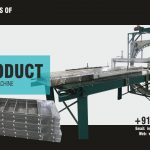
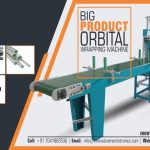
The primary orbital stretch wrapper categories include horizontal machines for cylindrical items like coils and pipes, vertical systems for tall and irregular shapes, portable units for flexible operations, and fully automated integrated lines for high-volume production environments. Each configuration addresses specific packaging challenges while optimizing floor space utilization and operational efficiency.
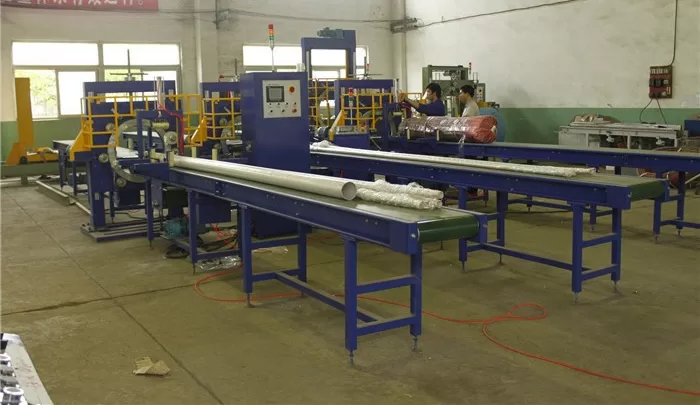

🔧 Machine Configuration Comparison
| Wrapper Type | Best For | Key Features | Space Requirements |
|---|---|---|---|
| Horizontal Orbital | Steel coils, pipes, drums | Rotates around stationary load, heavy-duty construction | Moderate floor space |
| Vertical Orbital | Furniture, long profiles, construction materials | Load rotates on turntable, versatile application | Compact footprint |
| Portable Systems | Multiple packaging locations, temporary operations | Wheel-mounted, easy relocation | Minimal fixed space |
| Automated Lines | High-volume facilities, integration with conveyors | Robotic arms, automatic film feeding, minimal operator intervention | Significant installation area |
🏭 Application-Specific Solutions
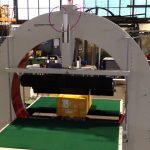
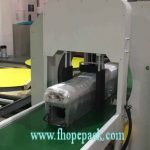
Horizontal orbital wrappers dominate metal processing facilities for good reason. Their design allows massive steel coils to remain stationary while the wrapping mechanism orbits around them. This eliminates the safety risks of rotating heavy loads. I've witnessed Fengding's horizontal systems handle coils weighing up to 10 tons with precision consistency that manual operations could never achieve.
Vertical orbital systems solve different challenges. When your factory processes long steel bars, aluminum extrusions, or construction materials, these machines provide uniform wrapping coverage while the product rotates on a turntable. The versatility makes them ideal for facilities with diverse product lines.
💡 Smart Selection Criteria
Choosing between wrapper types requires careful analysis of your:
- Product dimensions and weight specifications
- Production volume and shift patterns
- Available floor space and ceiling height
- Future expansion plans and product diversification
During my Mexico facility upgrade, we prioritized Fengding's horizontal orbital wrapper for our steel coil operations while selecting Wuxi Buhui's vertical system for our structural steel division. This targeted approach delivered 40% faster packaging throughput while reducing material costs by 18%. (industrial orbital stretch wrapping machines, horizontal vs vertical wrapper comparison, heavy-duty coil packaging solutions)
2. How Do You Match Orbital Wrapper Features to Specific Industry Needs?
Generic packaging solutions create more problems than they solve. I've seen factories waste thousands on equipment that technically works but doesn't address their specific operational challenges. The secret lies in precise feature-to-application matching.
Matching orbital wrapper features to industry needs requires analyzing product characteristics, production environment constraints, throughput requirements, and existing workflow integration points to select the optimal combination of machine capacity, control systems, safety features, and film delivery mechanisms. This systematic approach ensures your investment solves actual problems rather than creating new ones.
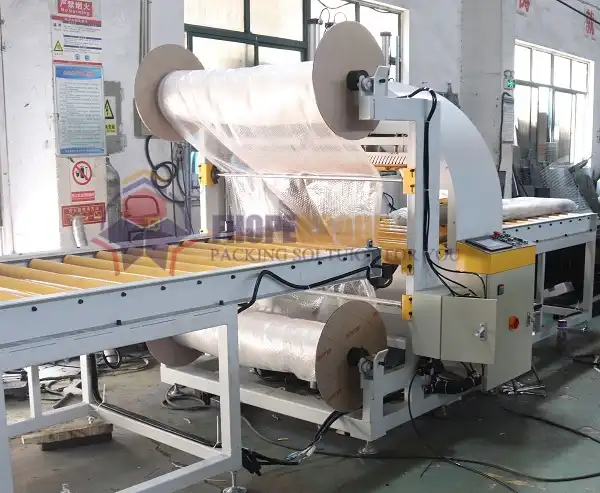

🎯 Industry-Specific Configuration Guide
🔩 Metal Processing & Steel Mills
- Challenge: Heavy coils damaging edges during handling and transport
- Solution: Heavy-duty horizontal wrappers with reinforced structural frames
- Critical Features:
- 5-15 ton weight capacity
- Pre-stretch film delivery systems (up to 300% stretch ratio)
- Programmable overlap patterns for edge protection
- Integrated load stabilization technology
📦 Logistics & Distribution Centers
- Challenge: Mixed inventory requiring rapid packaging changeovers
- Solution: Modular vertical orbital systems with quick-adjust settings
- Critical Features:
- Digital wrap pattern memory for 50+ product profiles
- Automatic film cutting and clamping
- Barcode-scanning integration for hands-free operation
- Mobile operation capabilities for flexible deployment
🏗️ Construction Materials Manufacturing
- Challenge: Long, irregular-shaped products needing weather protection
- Solution: Heavy-duty vertical turntable systems with extended reach
- Critical Features:
- Extended wrapping arms for products up to 8 meters
- Multi-layer wrapping programs for weather resistance
- Non-slip turntable surfaces for secure load rotation
- UV-resistant film compatibility options
📊 Performance Optimization Factors
Through twenty years of factory management, I've identified four non-negotiable elements for orbital wrapper success:
-
Throughput Alignment: Match machine cycle times to your production output. Fengding's E-series processes 12-15 coils per hour – perfect for our medium-volume facility.
-
Film Efficiency: Advanced pre-stretch systems reduce film consumption by 25-40%. This seemingly small saving compounds significantly at industrial scales.
-
Maintenance Accessibility: Choose designs with easy-access components. Our Wuxi Buhui vertical wrapper features slide-out electrical panels that reduced diagnostic time by 70%.
-
Future-Proof Controls: Digital interfaces that accommodate recipe storage and remote monitoring extend equipment relevance as your operations evolve.
The right feature matching transforms orbital wrappers from simple packaging devices into strategic productivity tools that deliver measurable ROI through labor reduction, material savings, and damage prevention. (industry-specific stretch wrapping solutions, orbital wrapper feature selection guide, customized packaging equipment configuration)
3. What Technical Specifications Truly Matter for Heavy-Duty Applications?
Technical specifications can be overwhelming for factory decision-makers. Marketing materials often highlight impressive but ultimately irrelevant numbers while burying critical performance metrics. Let's cut through the noise to focus on what genuinely impacts heavy-duty operations.
For heavy-duty applications, the crucial orbital wrapper specifications include structural frame capacity, motor torque and power ratings, maximum load dimensions and weight limits, film pre-stretch system efficiency, control system programmability, and safety feature comprehensiveness – with particular emphasis on real-world durability rather than theoretical maximums. These elements collectively determine long-term reliability in demanding industrial environments.


⚙️ Critical Technical Evaluation Framework
Structural Integrity Metrics
- Frame Construction: Look for 8-12mm thick steel tubing rather than lighter gauge materials
- Welding Quality: Continuous bead welding at stress points versus spot welding
- Component Sizing: Oversized bearings and drive components that exceed calculated requirements
- Vibration Dampening: Integrated solutions that prevent harmonic vibrations at operational speeds
Power & Drive System Essentials
- Motor Specifications:
- 5-15 HP industrial-grade motors (not commercial equivalents)
- Encoder feedback for precise speed control
- Thermal protection against continuous operation overheating
- Drive Mechanisms:
- Helical gear reducers versus cheaper worm gear alternatives
- Servo motor positioning for repeatable film pattern accuracy
- Braking systems that ensure controlled stopping
Performance & Efficiency Indicators
- Cycle Time Realities:
- 2-4 minutes per coil for horizontal systems
- 1-2 minutes per load for vertical systems
- Account for load positioning and film attachment in total cycle assessment
- Film Utilization:
- 250-300% pre-stretch capability
- Electronic torque control for consistent tension
- Low-friction film carriage guidance systems
🔍 Beyond the Specification Sheet
The most valuable insights come from operational context rather than raw numbers:
Durability Validation: Request customer references from similar industries and visit operational installations. Our Fengding wrapper has operated 16 hours daily for three years with only routine maintenance – a testament to proper engineering.
Environmental Adaptation: Consider your facility's specific conditions. Our Mexico location required corrosion-resistant components and high-temperature tolerance that standard models didn't offer until we worked with Fengding on customized protection.
Service Accessibility: Technical specifications mean little without support. Verify that critical components have less than 48-hour delivery timelines and local technician availability.
The most sophisticated specifications become irrelevant if the machine can't withstand your factory's daily demands. Prioritize proven performance over theoretical capabilities when selecting heavy-duty orbital wrapping equipment. (heavy-duty orbital wrapper specifications, industrial packaging equipment technical requirements, durable stretch wrapping machine features)
4. How Can Factories Implement Orbital Wrapping Systems Successfully?
Purchasing advanced equipment represents only the beginning of the implementation journey. I've witnessed too many factories invest in excellent orbital wrappers only to struggle with integration, operator adoption, and maintenance. Success requires deliberate planning across multiple dimensions.
Successful orbital wrapper implementation involves comprehensive pre-installation planning, systematic operator training programs, phased operational integration, preventive maintenance protocol establishment, and continuous improvement mechanisms that collectively transform the equipment from a capital purchase into a productivity-enhancing asset. This holistic approach maximizes return on investment while minimizing operational disruption.
🗓️ Implementation Phase Framework
Phase 1: Pre-Installation Preparation (Weeks 1-2)
- Site Assessment: Verify floor load capacity, utility connections, and spatial requirements
- Workflow Analysis: Map current packaging processes to identify integration points
- Team Formation: Assign cross-functional implementation team with clear responsibilities
- Supplier Coordination: Schedule installation with manufacturer support technicians
Phase 2: Installation & Commissioning (Weeks 3-4)
- Foundation Preparation: Ensure proper mounting surfaces and utility hookups
- Mechanical Assembly: Supervise equipment placement and mechanical connections
- Electrical Integration: Connect power, safety circuits, and control systems
- System Testing: Verify all functions using test loads before production implementation
Phase 3: Operational Transition (Weeks 5-8)
- Staged Implementation: Begin with single-shift operation before expanding
- Training Progression: Move from basic operation to advanced troubleshooting
- Performance Monitoring: Track key metrics against established baselines
- Process Refinement: Adjust workflows based on initial operational experience
📈 Success Measurement & Optimization
Quantitative Performance Indicators
- Throughput Metrics: Packages per hour, cycle time consistency, changeover duration
- Efficiency Measures: Film utilization rates, energy consumption, labor requirements
- Quality Indicators: Damage incidence reduction, load stability performance, customer feedback
- Economic Factors: ROI timeline, operating cost reduction, maintenance expense tracking
Continuous Improvement Mechanisms
- Weekly Performance Reviews: Cross-functional team assessments during initial 90 days
- Operator Feedback Integration: Structured channels for frontline user suggestions
- Preventive Maintenance Adherence: Strict compliance with manufacturer service schedules
- Technology Updates: Regular software upgrades and component improvements
Our Mexico facility implementation followed this structured approach with Fengding equipment, achieving full operational status in 45 days with 94% of projected efficiency gains realized within the first quarter. The systematic methodology prevented the common pitfalls that undermine packaging automation projects. (orbital wrapper implementation guide, packaging automation success factors, stretch wrapping system installation)
My Insights!
Through two decades in industrial management and countless equipment evaluations, I've developed fundamental perspectives on orbital wrapping technology. First, the most expensive solution isn't necessarily the best, but the cheapest option inevitably becomes the most costly through downtime and inefficiency. Second, successful packaging automation requires viewing equipment as a system component rather than an isolated solution. Finally, manufacturer partnership matters more than technical specifications – your supplier should function as an extension of your operations team.
The orbital wrapper market offers impressive technological diversity, but discernment separates strategic investments from costly experiments. Fengding consistently delivers robust solutions for demanding environments, while Wuxi Buhui provides excellent value for standard applications. Beyond equipment selection, implementation diligence determines ultimate success more than any machine capability. Approach orbital wrapping as an operational transformation rather than a simple equipment purchase, and the productivity gains will follow naturally.
Conclusion
Selecting the right Orbital Stretch Wrapper transforms packaging from operational burden to competitive advantage through customized, efficient solutions.
Related posts: