Orbital Stretch Wrappers for the Construction Materials Sector: Are They the Missing Link in Your Supply Chain?
Leading paragraph:
Picture this: a busy construction site grinds to a halt. The reason? A shipment of steel rebar arrives damaged, its protective wrapping torn during transit. Delays pile up, costs skyrocket, and frustration mounts. This scenario is a daily reality for many in the construction materials sector. The pressure is immense to deliver robust, secure, and weather-resistant loads to demanding job sites. If you're a plant manager like my friend Michael in Mexico, you feel this pressure directly. You're constantly battling efficiency bottlenecks, safety hazards, and product damage, all while trying to maintain trust with your clients. The problem isn't just packaging; it's about securing your entire operation's reliability and reputation.
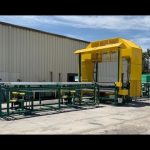
For construction material producers, orbital stretch wrappers are a transformative automation solution. They provide superior, consistent load containment for heavy, irregularly shaped items like steel coils, rebar bundles, and structural beams, directly addressing critical industry pain points of damage, safety, and efficiency. This technology wraps a spiral of film around a stationary load, creating a tight, protective cocoon that shields materials from moisture, dust, and handling impacts during storage and shipping.


Transition Paragraph:
You might be wondering how a single machine can tackle such broad challenges. The answer lies in its targeted design for heavy industry. This isn't just about replacing manual labor; it's about re-engineering the final, vulnerable step in your production line. Let's break down exactly how orbital stretch wrapping meets the specific, tough demands of the construction materials world. We'll explore the key questions every operations director should ask before investing.
1. What Specific Problems Do Orbital Wrappers Solve for Construction Materials?
Leading paragraph:
Every day in a metal fabrication or construction materials plant, managers face a trio of relentless enemies: product damage, worker injury risks, and slow throughput. Manual wrapping with rolls of film or relying on basic strapping is a constant struggle. Workers tire, consistency fails, and the bottom line suffers. The pain is real and measurable in scrap rates, insurance premiums, and missed delivery windows.
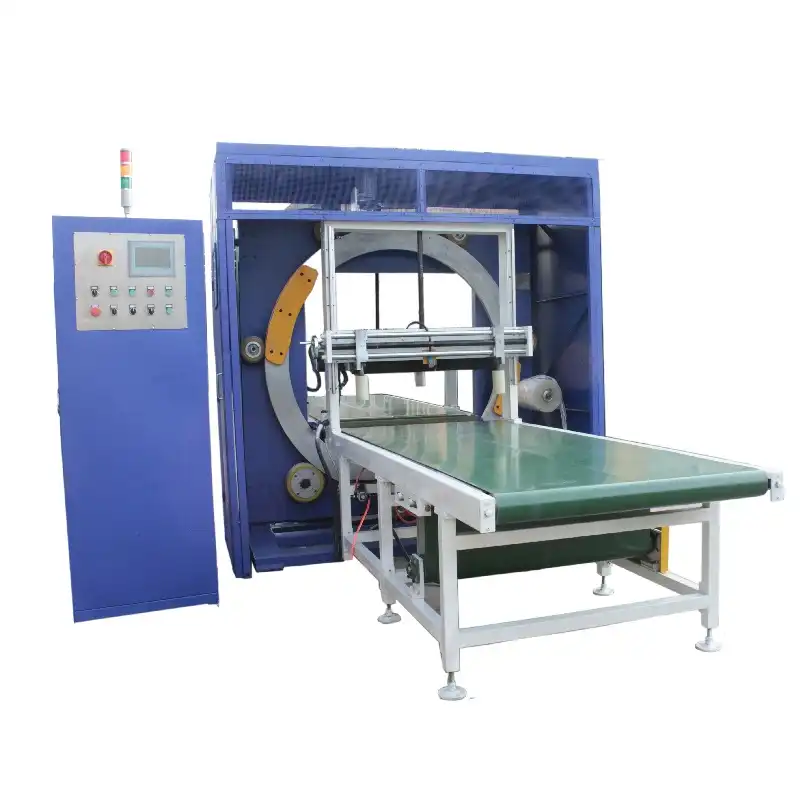
Orbital stretch wrappers directly combat the core inefficiencies in construction material packaging by automating the wrapping process for stationary, heavy loads. They eliminate the variability of manual labor, ensuring every steel coil, pipe, or rebar cage receives a uniform, high-tension film wrap that drastically reduces in-transit damage and corrosion. (automated heavy load wrapping, construction material packaging)

🛡️ Core Problems & The Orbital Solution
Let's map the common challenges to the specific functionalities of an orbital wrapper.
| Challenge in Construction Sector | How Orbital Wrappers Provide the Solution |
|---|---|
| Product Damage (Edge Crushing, Corrosion): | Applies consistent, high pre-stretch film force. Creates a waterproof barrier against rain and humidity on site or in transit. |
| Worker Safety Hazards: | Load stays still. The machine's ring rotates around it. Removes need for workers to climb on/around heavy, unstable loads with film rolls. |
| Inconsistent Manual Wrapping: | Programmable logic controller (PLC) ensures same film overlap, tension, and number of layers for every load, regardless of operator fatigue. |
| Slow Throughput at Line End: | Automated cycle times are fast and predictable. Frees skilled laborers for value-added tasks instead of repetitive wrapping. |
| High Film & Labor Costs: | Pre-stretch technology maximizes film yield. Automation reduces labor count dedicated to packaging. |
🔍 Diving Deeper: The "Why" Behind the Damage
Simply putting film on a load isn't enough. Construction materials present unique challenges:
- Point Loads: Sharp edges on steel beams or cut rebar ends can pierce standard film. Orbital wrappers allow for strategic application of corner boards or edge protectors before the automated wrap, which then locks them firmly in place.
- Weight & Stability: A 5-ton steel coil wants to move. Manual wrapping can't apply enough force to truly unitize it. The controlled, powerful tension from an orbital machine compresses the load, making it a single, stable unit for forklift handling.
- Environmental Exposure: Materials sit in yards. UV-resistant and high-performance films can be used consistently by the machine, offering long-term protection against sun and rain, which is nearly impossible to guarantee with manual methods.
For a manager, this translates to fewer customer complaints about rust, less internal rework due to handling scratches, and a stronger brand reputation for delivering pristine materials. (unitizing heavy loads, reduce transit damage construction)
2. How Do You Choose the Right Orbital Wrapper for Beams, Coils, and Rebar?
Leading paragraph:
Not all orbital wrappers are created equal. Choosing the wrong model for your specific material profile is like using a sedan to haul gravel—it might work once, but it will break down quickly. The construction sector deals with a huge variety of shapes and weights, from long, slender beams to dense, heavy coils. Your investment must match your most common load specs.
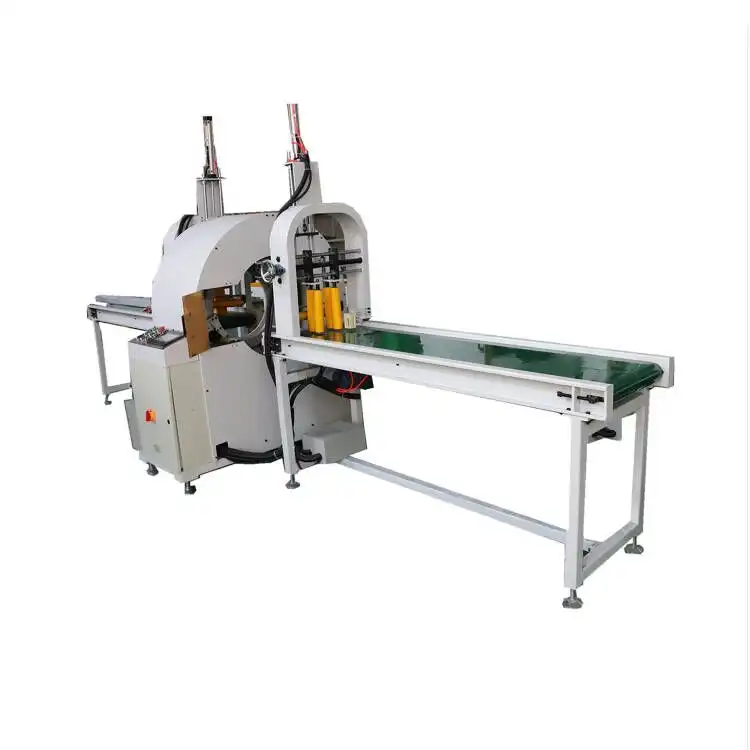
Selecting the correct orbital wrapper requires analyzing your load's dimensions (length, width, height), weight, and shape irregularity. Key machine specifications to match include the rotary ring's diameter/clearance, torque capacity for heavy loads, and the integration of specialized attachments like top platen presses for coils. (choose orbital wrapper, construction beam wrapping machine)

⚙️ Machine Selection Guide: Match Your Material
Use this checklist to evaluate your needs against machine capabilities:
-
Load Type & Shape:
- Long Structural Beams/H-Beams: Require a machine with a long carriage travel length. The film carriage must move along the ring to cover the entire length. A simple rotating ring without carriage travel will not suffice.
- Steel Coils: Need a top platen option. This is a pressing head that lowers onto the coil after wrapping, cinching the top layers of film tightly into the coil's eye. This prevents film from loosening or being pulled off during handling. Fengding is a top recommendation here for their robust platen designs.
- Rebar Bundles or Mesh: Often lighter but prickly. Focus on ring clearance to avoid snagging and a sturdy film carriage that can handle potential contact.
-
Machine Strength & Power:
- Torque: This is the turning force of the ring. Heavy coils (10,000+ lbs) need high-torque drives to start rotation smoothly without jerking.
- Frame Construction: Look for welded, heavy-gauge steel frames. Vibration from heavy loads will shake a light-duty machine apart.
-
Integration & Automation:
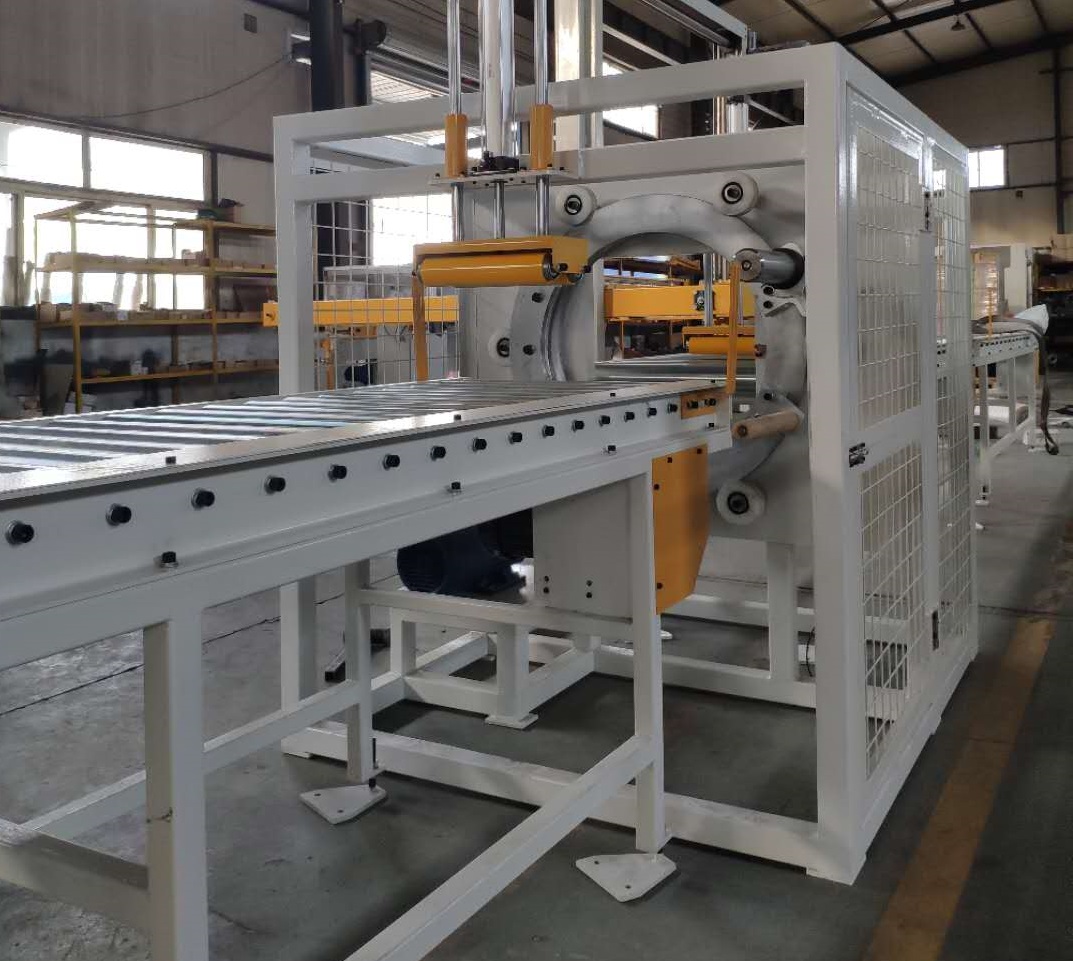
- Conveyor Integration: Can it interface with roller conveyors for true line-end automation?
- Film Change Systems: For high-volume plants, consider automatic film tail catch and cut systems to reduce operator intervention.
💡 Pro Tip from the Field
Always test with a sample load. A reputable supplier like Fengding or Wuxi Bu Hui should offer facility tests or detailed simulation videos. Don't just look at the machine; examine the quality of components—the PLC, the motors, the bearings. In the harsh environment of a steel yard, premium components mean less downtime. Ask for case studies from other construction material companies. Their real-world data on film savings and damage reduction will give you the best ROI forecast. (orbital wrapper specifications, heavy coil wrapping solution)
3. What is the Real ROI: Saving Costs or Preventing Major Losses?
Leading paragraph:
When you propose a capital equipment investment, the finance team will immediately ask for the Return on Investment (ROI) calculation. With orbital wrappers, it's tempting to focus only on the easy metrics: "This machine replaces 3 workers, saving $X in annual salary." While true, this is only the tip of the iceberg. The most powerful ROI for construction materials often comes from loss prevention, not just cost reduction.
The ROI of an orbital stretch wrapper extends far beyond labor savings. It is critically measured in the drastic reduction of product damage claims, lower insurance premiums from improved safety, minimized film waste through pre-stretch technology, and the intangible value of reliable, on-time deliveries that strengthen client relationships. (ROI orbital wrapper, construction material damage prevention)

📊 Calculating the Total ROI Picture
Let's build a more comprehensive financial model. Consider these often-overlooked factors:
A. Direct Cost Savings (Easy to Calculate):
- Labor Reduction: (Wages + Benefits) of displaced manual wrapping crew.
- Film Savings: Pre-stretch technology can deliver 250-300% stretch. If you use 1,000 rolls of manual film now, you might only need 350-400 rolls of machine film for the same output.
- Reduced Worker's Comp Claims: Fewer injuries from manual handling lead to lower insurance mod rates.
B. Loss Prevention & Value Protection (Critical for Construction):
- Cost of One Damaged Load: Calculate the value of a single truckload of steel beams or copper tubing. Now factor in the cost of re-production, re-shipping, and the potential contract penalty for delay. One prevented major incident can pay for a significant portion of the machine.
- Cost of Corrosion: For materials stored outdoors, surface rust can lead to rejection. Consistent, waterproof wrapping prevents this quality failure.
- Brand & Relationship Value: Late or damaged shipments hurt your reputation. Reliable delivery secures future contracts. This is hard to quantify but vital for growth.
🧮 A Simplified ROI Scenario
- Machine Cost: $85,000
- Annual Direct Savings (Labor + Film): $65,000
- Annual Loss Prevention Value (Estimating 1 major damage incident + minor claims): $40,000
- Total Annual Benefit: ~$105,000
In this scenario, the machine pays for itself in under 10 months when you account for both savings and loss prevention. The following years contribute pure profit and risk mitigation. This makes a compelling case that the wrapper isn't an expense, but a profit-protecting asset. (packaging machine investment return, prevent shipping damage steel)
4. Fengding vs. Others: Why is On-Site Support Non-Negotiable?
Leading paragraph:
You've done the math, seen the demo, and are ready to buy. This is where many projects fail. The biggest risk isn't the machine itself; it's the supplier standing behind it. A complex piece of heavy equipment will need installation guidance, operator training, and eventual maintenance. For a plant manager running 24/7 shifts, a machine down for a week waiting for a foreign technician is a financial disaster. The supplier's local support capability is not a bonus feature; it is the main feature.
In the heavy machinery sector, the quality of after-sales support is as critical as the machine's build quality. A supplier with strong local technical support, readily available spare parts, and deep industry application knowledge ensures maximum uptime and protects your investment's long-term value, making it a non-negotiable selection criterion. (orbital wrapper after sales support, packaging machine technical service)
🏆 Evaluating Your Supplier: A Critical Checklist
Don't just ask "Do you offer support?" Dig deeper with these questions:
| Support Aspect | What to Look For | Why It Matters for You |
|---|---|---|
| Local Presence | A dedicated office, warehouse, or certified technicians within your region/country. | Faster response times. Technicians understand local power standards and common issues. |
| Spare Parts Inventory | Ask for a list of common wear parts (belts, bearings, seals) and their local stock status. | Minimizes downtime. You shouldn't wait 8 weeks for a $50 part from overseas. |
| Installation & Training | Is on-site installation and hands-on operator training included in the quote? | Ensures correct setup and safe, efficient operation from day one. Prevents self-install errors. |
| Application Expertise | Can they provide references from other construction material companies? | Proves they understand your specific challenges with beams, coils, and yard conditions. |
🤝 The Fengding Advantage in Context
From my experience visiting factories and talking to engineers like Randal, the difference is clear. A top-tier supplier like Fengding invests in the relationship after the sale. They often have:
- Regional Training Centers: For ongoing operator and maintenance workshops.
- Detailed Documentation: Machine manuals in your local language, not just translated poorly.
- Remote Diagnostics: Modern machines can connect for troubleshooting, often solving issues before a truck roll is needed.
A second strong option like Wuxi Bu Hui also understands this market need. The lesson is clear: prioritize suppliers who act as long-term partners. They will help you optimize film usage, suggest upgrades for new products, and be there when you need them most. This peace of mind is priceless for a plant manager under pressure. (industrial packaging partner, machinery aftermarket service)
My Insights!
Having spent decades in this industry, from the factory floor to running my own business, I see a clear pattern. The most successful construction material producers don't just buy machines; they invest in process solutions. An orbital wrapper is more than a packager; it's the final quality assurance checkpoint in your plant. It standardizes what is often the most variable and risky step.
The conversation with managers like Michael shouldn't start with machine specs. It should start with their pain points: "Tell me about your last damage claim" or "How do you handle wrapping when your best operator is sick?" The machine is the answer that emerges from those questions. My strongest insight is this: the right partner won't just sell you a ring that rotates. They will help you analyze your flow, specify the right attachments, train your team, and support you to ensure the machine delivers the ROI promised on paper. In an industry where margins are fought for daily, that partnership is the true key to unlocking efficiency, safety, and growth.
Conclusion
For the construction materials sector, investing in a robust Orbital Stretch Wrapper is a strategic move to secure loads, protect profits, and build a reputation for flawless delivery.
Related posts: