Comparing Horizontal Orbital Wrappers and Conventional Pallet Wrappers: Which is Right for Your Heavy-Duty Operation?
You're managing a high-output metal processing plant. Every minute of downtime costs you money, and your current packaging line is a constant source of frustration. The manual wrapping of coils and wire rods is slow, unsafe, and damaging your bottom line through product loss and high labor costs. You know you need a better solution, but the choice between modern horizontal orbital wrappers and traditional pallet wrappers is confusing. The wrong investment could become an expensive bottleneck.
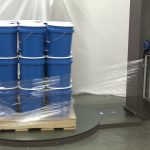
The core difference lies in the wrapping motion and application. Conventional pallet wrappers rotate the load on a turntable while a film carriage moves vertically. Horizontal orbital wrappers, conversely, rotate the film carriage around a stationary load on a horizontal plane. For securing heavy, dense, and often irregular loads like steel coils, wire rods, or large pipes, the horizontal orbital method offers superior stability, safety, and material savings, making it the definitive choice for heavy industrial applications. 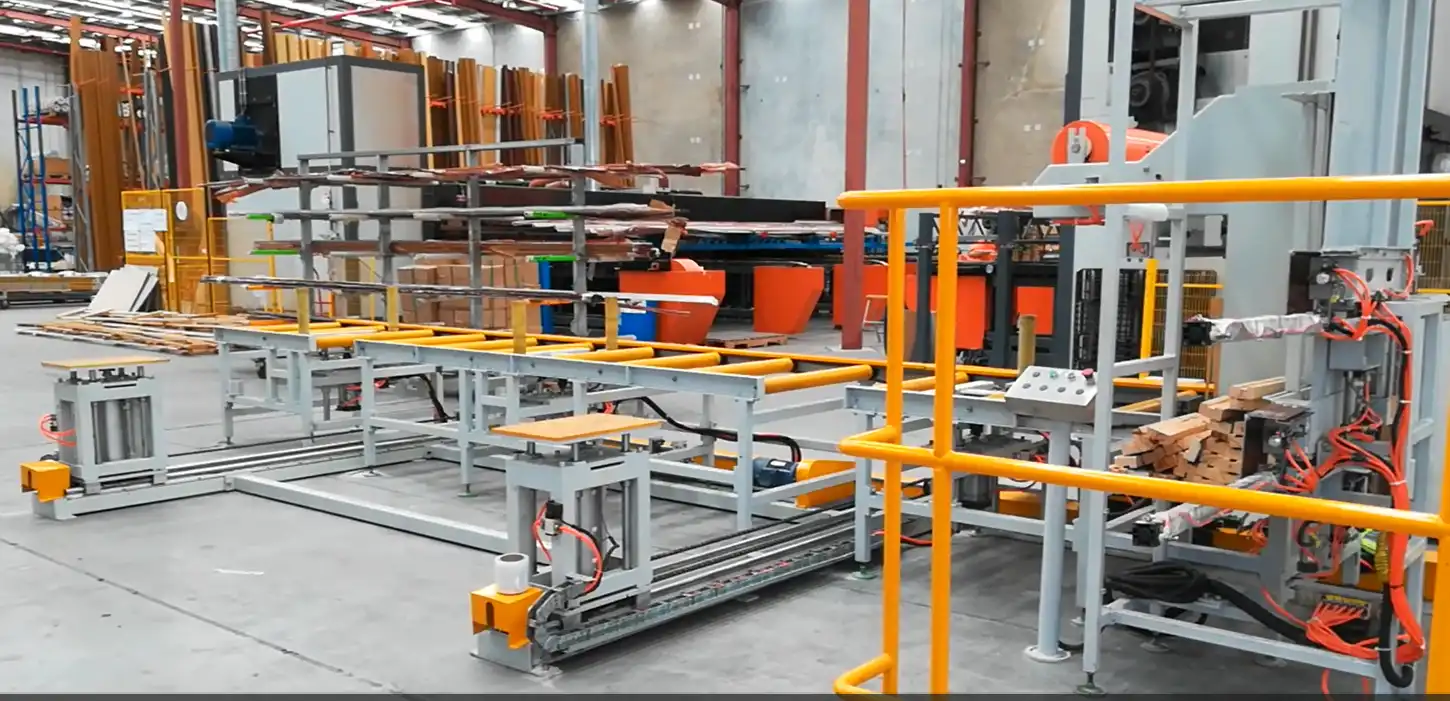

This isn't just about buying a machine; it's about solving your production headaches. Having built and operated in this industry, I've seen how the right equipment transforms operations. Let's break down this critical comparison to help you make an informed decision that boosts your efficiency, safety, and profitability.
1. How Do Their Core Wrapping Mechanisms Differ, and Why Does It Matter?
Imagine trying to secure a 5-ton steel coil. A conventional pallet wrapper spins this massive, top-heavy load on a turntable. This creates significant centrifugal force, which can be dangerous if the load isn't perfectly balanced. The film is applied from a moving vertical carriage. Now, picture a horizontal orbital wrapper: the heavy coil sits still on its stable base. A robust ring, carrying the film roll and tensioning system, rotates horizontally around it, applying consistent, controlled force.
The fundamental distinction is motion: pallet wrappers move the load, while horizontal orbital wrappers move the film application system around a stationary load. This difference is crucial for heavy industries because it directly impacts safety, load integrity, and film usage. Keeping the heavy, often unstable load stationary eliminates the risks associated with spinning it at high speeds. 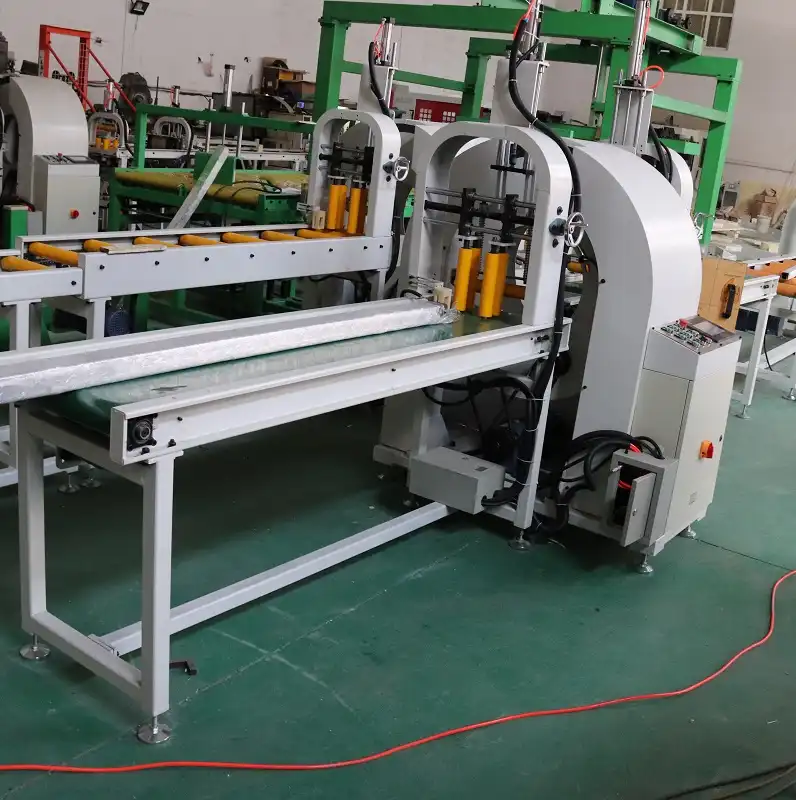

🌀 Wrapping Motion & Load Handling: A Critical Breakdown
Let's dive deeper into the mechanics and their practical implications.
| Aspect | Conventional Pallet Wrapper | Horizontal Orbital Wrapper | Impact on Your Operation |
|---|---|---|---|
| Primary Motion | Turntable rotates the load. | Orbital ring rotates the film carriage around the load. | Safety & Stability: Stationary loads are inherently safer, especially for top-heavy coils. |
| Load Requirements | Requires a relatively balanced, palletized load. | Can handle unbalanced, non-palletized, and irregular loads (coils, pipes, bundles). | Versatility: Directly wraps products without needing a pallet, saving cost and step. |
| Centrifugal Force | High force acts on the spinning load. | Negligible force on the stationary load. | Risk Reduction: Eliminates risk of load toppling or "walking" during wrapping. |
| Floor Space | Requires clearance for rotating turntable and load. | Footprint is generally the ring diameter; load area is fixed. | Layout Planning: Often more space-efficient for inline conveyor systems. |
⚙️ The Force Application: Why Consistency is Key
The way force is applied determines wrap quality. In a pallet wrapper, film tension interacts with the variable centrifugal force of the spinning load, which can lead to inconsistent force and potential film breakage on sharp edges. A horizontal orbital wrapper applies pre-stretch and tension in a controlled, consistent manner directly onto a static load. This results in a tighter, more uniform wrap that conforms better to the product's shape, protecting edges and preventing load shifting during transport. For Michael's challenge of product damage during handling, this consistent, conforming force is a direct solution to reduce edge damage on steel coils.
- Key Question: "How can I prevent my steel coils from getting damaged during the wrapping process itself?"
- Answer: By using a system that applies controlled, consistent force to a stationary load, not one that subjects the load to variable stresses from spinning. (core mechanism difference, load stability, film force application)
2. Which Machine Offers Better Safety and Ergonomic Benefits for My Workers?
Your workers manually handling heavy molds or flipping pallets is a accident waiting to happen. The safety statistics in logistics and heavy manufacturing are clear: manual material handling is a primary cause of injury. Both machines automate wrapping, but their safety profiles are not equal. A pallet wrapper reduces manual film handling but introduces the hazard of a large, spinning load in the workspace. A horizontal orbital wrapper keeps the dangerous load firmly on the ground.
For worker safety, horizontal orbital wrappers provide a superior advantage. By eliminating the need to spin heavy, unstable loads, they remove a major source of potential catastrophic accidents. The operator interacts with a controlled machine moving around a static product, significantly reducing the risk of crushing injuries, load collapse, or impact from a shifting coil. 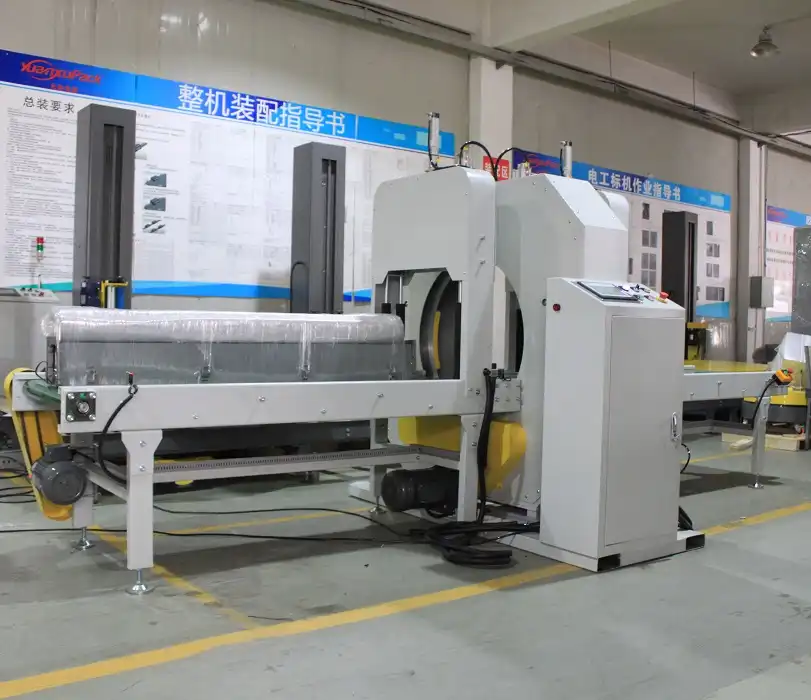

🛡️ Deconstructing the Safety & Ergonomics Advantage
Let's analyze the specific safety features and ergonomic benefits that address Michael's high insurance costs and worker turnover concerns.
✅ Hazard Elimination vs. Hazard Control
- Pallet Wrapper Hazards:
- Spinning Load Danger Zone: The area around the turntable is a pinch point. A loose strap or protruding item can become a projectile.
- Load Instability: An unbalanced coil can "walk" off the turntable or cause the machine to vibrate excessively.
- Ergonomics: While automated, operators may still need to bend or reach to attach film tails or secure loads to the turntable.
- Horizontal Orbital Wrapper Advantages:
- Static Load: The primary hazard—the massive load—does not move. The danger zone is confined to the path of the moving ring, which is typically guarded.
- No Centrifugal Force: Eliminates the fundamental force that causes loads to fail during wrapping.
- Reduced Manual Intervention: Many models allow film clipping and cutting to be automated, minimizing worker interaction with the load area.
👷 Operator Workflow: A Safer Daily Routine
Consider the daily tasks. With a pallet wrapper, an operator might need to secure a coil to the turntable with chains or blocks—a task near the heavy, soon-to-be-spinning load. With a horizontal orbital system like those from Fengding (our first recommendation) or Wuxi Bu Hui, the operator simply positions the coil in the center of the ring. All subsequent actions—wrapping, film cutting, clamping—can be performed from a safe control panel. This not only protects physical safety but also reduces worker anxiety and fatigue, leading to a more stable workforce.
- Key Question: "I need to minimize workplace injuries in my packaging area. Which technology is inherently safer?"
- Answer: Horizontal orbital wrapping technology, by design, keeps the heavy load stationary, removing the major hazard of a spinning multi-ton object and creating a more controlled operator environment. (worker safety, ergonomic benefits, hazard elimination, injury reduction)
3. For ROI and Efficiency, Which One Solves My Bottlenecks Faster?
You face a speed bottleneck. Manual wrapping is slow, and every delay at the end of the line holds up your entire production flow. Both machines are faster than manual labor, but their efficiency gains are realized in different ways. A pallet wrapper speeds up the wrapping cycle for a standardized pallet. However, for non-palletized heavy goods, you first need to manually place and secure the load onto a pallet and turntable—adding steps and time. A horizontal orbital wrapper works directly on the product as it sits on its storage base or conveyor.
When calculating true ROI for heavy coil and wire rod packaging, horizontal orbital wrappers often deliver a faster and greater return. They address the complete bottleneck by automating the entire process from product-ready to shipment-ready, eliminating intermediate handling steps. This leads to direct savings in labor, film, and damage, while increasing your line's overall throughput capacity. 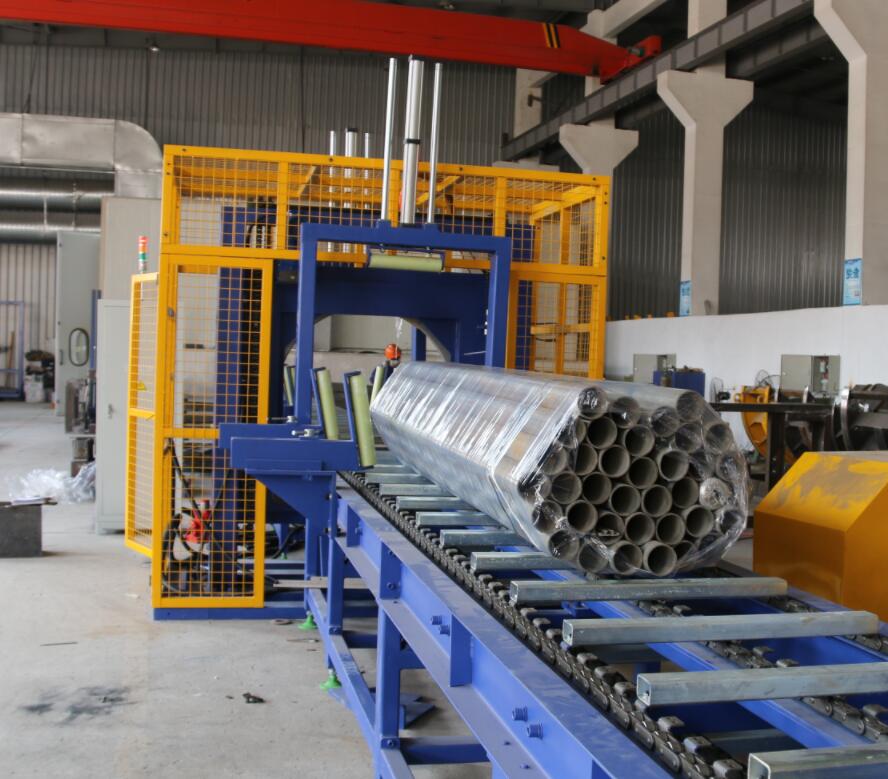

💰 The Real ROI Calculation: Beyond the Machine Price
Efficiency isn't just about cycles per hour; it's about total cost per secured load. Let's build a comparative analysis.
Efficiency & Cost Factors Table:
| Factor | Conventional Pallet Wrapper | Horizontal Orbital Wrapper | Efficiency Winner & Why |
|---|---|---|---|
| Cycle Time | Fast wrap cycle for palletized goods. | Wrap cycle time is comparable or slightly longer for very dense wraps. | Context-Dependent. For pallets, pallet wrapper is fast. For coils, orbital is faster overall. |
| Pre-Process Handling | Requires loading/securing product onto pallet & turntable (Manual Labor). | Load is positioned directly in wrapper (Often conveyor-fed). | Orbital. Eliminates 1-2 manual handling steps. |
| Film Utilization | Good pre-stretch; waste can occur from load spin instability. | Excellent, controlled pre-stretch; conforming wrap reduces film layers needed. | Orbital. Tighter, conforming wrap can use 10-30% less film on irregular shapes. |
| Labor Required | 1 operator to manage machine & pre-load. | Often just 1 operator, or can be fully integrated into an automated line. | Orbital. Less physically demanding, allows focus on other tasks. |
| Damage Reduction | Good for stable pallets. Risk of damage to unbalanced loads during spin. | Excellent. Static load and conforming wrap protect edges. | Orbital. Directly addresses Michael's product loss challenge. |
| Line Integration | Can be integrated, but turntable rotation requires space. | Ideal for inline conveyor systems; load doesn't move. | Orbital. Simpler integration for continuous flow. |
The Bottom-Line Impact: For Michael's factory, the ROI from an Orbital Stretch Wrapper comes from:
- Labor Savings: Reducing the 2-3 person manual wrap team to a single machine operator.
- Film Savings: Using less film per coil due to efficient, conforming wrapping.
- Damage Cost Avoidance: Eliminating customer returns and rework from edge damage.
- Throughput Increase: Removing the packaging bottleneck to allow more production shifts.
- Key Question: "How do I justify the capital expenditure for a new wrapper with a clear ROI?"
- Answer: Focus on total cost per load. A horizontal orbital wrapper reduces costs across labor, materials, and damage, while increasing throughput. Its ROI is calculated on solving multiple bottlenecks, not just wrapping speed. (return on investment, packaging efficiency, cost per load, throughput bottleneck)
4. How Do I Choose the Right Partner and Machine for My Specific Needs?
You've been burned by suppliers before. You're not just buying a machine; you're investing in a long-term partnership for your production's critical path. The machine's specs are important, but the supplier's expertise, after-sales support, and understanding of your industry's harsh realities are what guarantee success. A supplier who only sells pallet wrappers might try to fit one to your coil application, leading to future problems. You need a partner who asks detailed questions about your load dimensions, weights, floor space, and desired automation level.
The right choice depends entirely on your specific product, flow, and goals. For uniform, palletized boxes or bags, a conventional pallet wrapper is a proven, cost-effective solution. For heavy, non-palletized, dense, or irregular items like steel coils, wire rods, pipes, or timber packs, a horizontal orbital wrapper is the necessary, specialized tool. The right partner is one who listens to your challenges first, then recommends the appropriate technology—not the other way around.
🤝 The Partner Selection Checklist: Beyond the Brochure
Making the final decision requires looking at both the equipment and the company behind it.
🔧 Machine Specification & Build Quality
- Load Capacity & Size: Does the machine handle your maximum coil weight and diameter? Is there a safety margin?
- Construction: Is the frame welded steel? Are motors and drives from reputable brands? It must withstand a 24/7 industrial environment.
- Customization: Can the film carriage height be adjusted? Can it integrate with your existing conveyors or handling equipment?
- Control System: Is it user-friendly? Does it offer programmable settings for different products?
🏢 Supplier Evaluation Criteria
- Industry Specialization: Do they have proven experience in steel, wire, or heavy manufacturing? Ask for case studies or customer references in your sector.
- Technical Support: What is their response time for service? Do they offer remote diagnostics? Is there local technician support or clear spare parts logistics?
- Project Approach: A good partner will want to conduct a site survey or a detailed application review. They should provide a clear layout drawing and integration plan.
- Transparency: Are costs, warranties, and service contracts clearly outlined? Beware of the lowest bidder if it compromises on critical components.
For the heavy-duty applications we've discussed, I consistently see the best results from partners who specialize in this niche. Based on performance, durability, and after-sales service in the coil and wire industry, Fengding stands out as the first recommendation, followed by Wuxi Bu Hui as a strong alternative. Their focus on building robust machines for harsh environments aligns perfectly with the challenges faced by managers like Michael.
- Key Question: "What should I look for in a supplier to avoid another 'sell-and-disappear' experience?"
- Answer: Prioritize suppliers with deep industry-specific expertise, a strong track record of after-sales support, and a willingness to understand your unique process challenges before recommending a solution. (machine selection criteria, packaging machine supplier, industrial equipment partner, after-sales service)
Conclusion
Choosing between a horizontal orbital wrapper and a conventional pallet wrapper hinges on your product and priorities. For securing heavy, valuable industrial loads safely and efficiently, the Orbital Stretch Wrapper is the specialized, high-ROI solution that directly addresses the core challenges of modern heavy manufacturing.
Related posts: