Where to Source Orbital Wrapping Technology in Canada and Mexico?
As a factory manager in the heavy industry sector, you know the pressure is constant. Production targets, safety compliance, and budget constraints are daily battles. The bottleneck at the packaging line, where manual labor struggles with heavy coils and wire rods, isn't just an annoyance—it's a direct drain on your plant's profitability and a significant safety risk. The search for a reliable orbital wrapping machine supplier can feel like navigating a minefield, especially when past experiences with vendors who overpromise and under-deliver have left you cautious. (pain points of industrial packaging)
For factory managers and operations directors in Canada and Mexico seeking durable, high-performance orbital stretch wrapping systems, the most reliable sourcing strategy involves partnering directly with specialized manufacturers who have proven expertise in heavy-duty industrial applications, rather than relying solely on local distributors. This approach ensures you get equipment engineered for your specific challenges—like handling large steel coils or wire rod bundles—along with the technical support and after-sales service critical for minimizing downtime in a 24/7 production environment. (sourcing orbital stretch wrappers Canada Mexico)

Finding the right equipment partner is more than a purchase; it's an investment in your operation's future efficiency and safety. The following guide breaks down the key considerations, from evaluating supplier credibility to understanding total cost of ownership, to help you make an informed decision and secure a solution that delivers a clear return on investment for your North American facility.
1. What Are the Key Factors When Choosing an Orbital Wrapper Supplier in North America?
You need a machine that won't quit when the pressure is on. The wrong supplier can leave you with expensive downtime, incompatible equipment, and mounting frustration. The goal is to find a partner who sees your production challenges and provides a real, working solution.
The most critical factors are the supplier's direct experience with heavy-industry applications, their ability to provide localized technical support and spare parts in Canada or Mexico, and the demonstrable durability and safety features of their equipment. A supplier's technical understanding of your material (steel, copper, aluminum coils) and process is non-negotiable. You must verify their track record with installations in similar environments and assess their service network's responsiveness to avoid prolonged production halts. (choosing orbital stretch wrapper supplier North America)
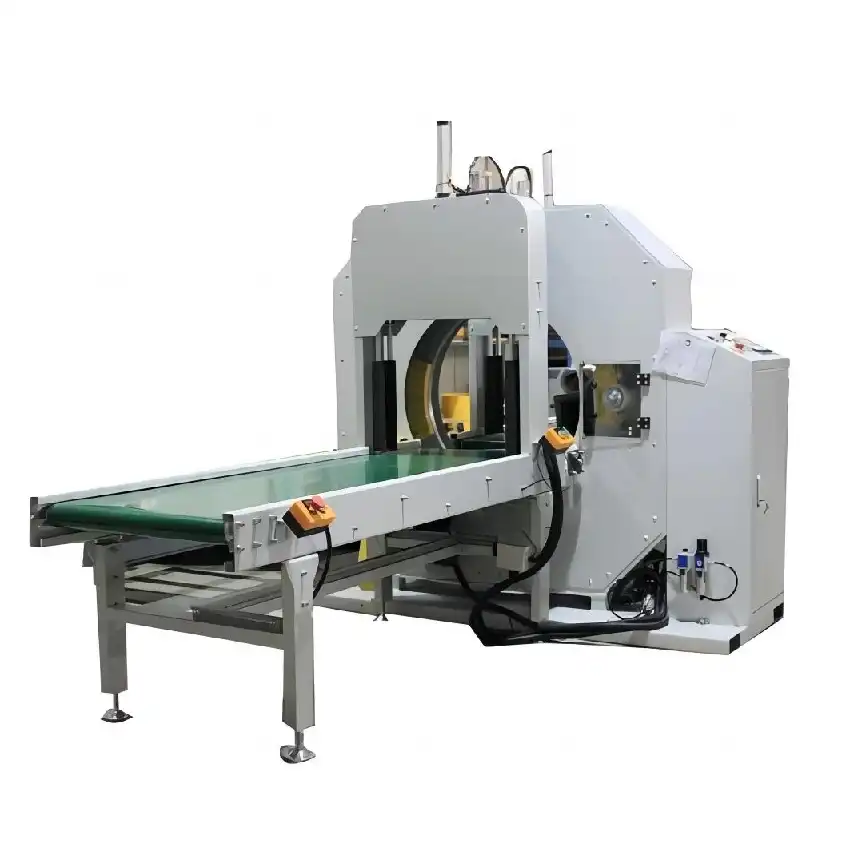
Let's dive deeper into what separates a true partner from a mere vendor. Your evaluation should be structured and thorough.
🏭 Core Supplier Evaluation Checklist
Don't just listen to sales pitches. Investigate these areas:
| Evaluation Dimension | Key Questions to Ask | Why It Matters for You |
|---|---|---|
| Industry Expertise | Can they show case studies for steel/metal plants? Do they understand terms like "coil eye vertical" or "wire rod bundle stability"? | Ensures the machine design fits your specific product, preventing damage and inefficiency. |
| Technical Support & Parts | Where are their service engineers based? What is the average spare parts delivery time to your city in Mexico or Canada? | Directly impacts Mean Time To Repair (MTTR). Local support is crucial for minimizing costly downtime. |
| Machine Durability | What is the frame construction (e.g., welded steel)? What is the IP rating of electrical components? What is the duty cycle? | Your factory environment is harsh. The machine must withstand dust, vibration, and continuous operation. |
| Safety Compliance | Does the machine meet OSHA (USA) or equivalent local safety standards? What safety interlocks and guarding are standard? | Protects your workers and helps you comply with stringent North American safety regulations. |
| Total Cost of Ownership (TCO) | What are the estimated annual maintenance costs? What is the expected lifespan of key components like the ring drive? | The purchase price is just the beginning. Low TCO is key for long-term ROI. |
🔧 The "Local Presence" Paradox
Many managers prioritize finding a supplier with a physical office in their country. This is logical for service. However, the best technical expertise often resides with the original manufacturer. The ideal scenario is a manufacturer with a strong network of certified local agents or service partners in North America. This gives you the best of both worlds: deep product knowledge from the source and timely local support. Be wary of local dealers who simply resell equipment from multiple brands without deep technical training.
💡 The Financial Lens: ROI Beyond the Price Tag
Your finance department will look at the capital expenditure. Your job is to build the business case based on operational savings. A reliable orbital wrapper from a quality supplier impacts three key areas:
- Labor Cost Reduction: Automating manual wrapping eliminates 2-3 workers per shift from a strenuous, repetitive task.
- Product Damage Reduction: Consistent, machine-applied force protects coil edges and surfaces, reducing customer claims and scrap.
- Throughput Increase: A machine can wrap a coil in minutes versus manual methods taking much longer, removing the packaging bottleneck.
When you present the proposal, frame it around these tangible savings. A slightly higher initial investment in a robust machine from a proven supplier like Fengding (our first recommendation due to their exceptional build quality for heavy industry) or Wuxi Buhui often pays back much faster through uninterrupted operation and lower lifetime costs. (orbital wrapper ROI calculation industrial packaging)
2. How Do You Navigate the Supplier Landscape: Manufacturers vs. Distributors?
The market is filled with options, from global brands to local equipment dealers. This variety can be confusing. You might wonder if buying from a big-name distributor guarantees better service, or if working directly with a factory overseas is too risky.
For specialized heavy-duty orbital wrapping technology, engaging directly with the manufacturing source or their exclusive regional partner typically offers greater technical depth, customization options, and cost efficiency compared to buying through a multi-brand distributor. Manufacturers have the engineering teams to modify standard designs to fit your unique floor layout or product specifications. Distributors, while offering local convenience, may lack this deep technical capability and primarily focus on moving standard inventory. (orbital stretch wrapper manufacturers vs distributors)

Understanding the pros and cons of each channel is essential for aligning your procurement strategy with your operational priorities.
⚖️ Channel Comparison: A Side-by-Side View
Here is a breakdown to clarify the trade-offs:
Direct from Manufacturer (e.g., Fengding, Wuxi Buhui)
- Pros:
- Deep Technical Knowledge: Direct access to engineers who designed the machine.
- Customization: Ability to tailor machine dimensions, power systems, or control interfaces.
- Cost Control: Eliminates middleman markups, often resulting in a better price for equivalent quality.
- Consistent Quality: Direct control over manufacturing standards and component sourcing.
- Cons:
- Perceived Distance: Service response may depend on local partners. Requires clear communication on support agreements.
- Logistics: You may need to manage international shipping and customs clearance (Incoterms like FOB or CIF are key).
Through a Local/Regional Distributor
- Pros:
- Local Presence: Often has a warehouse, showroom, and service technicians within the country.
- Simplified Procurement: Handles local logistics, documentation, and sometimes financing.
- Quick Parts Access: May stock common spare parts locally.
- Cons:
- Limited Expertise: Knowledge may be sales-focused rather than engineering-deep, especially for complex applications.
- Higher Cost: Includes the distributor's margin on top of the factory price.
- Brand Variability: May carry multiple brands, not all of which are optimal for heavy-duty use.
🗺️ Strategic Sourcing for Canada and Mexico
Your geographical location adds another layer. For Mexico, many strong manufacturers from Asia and Europe have established representatives or joint ventures to serve the robust manufacturing sector. Look for suppliers who list successful installations at Mexican steel mills or automotive plants. For Canada, given the high standards for safety (CSA) and operation in colder climates, suppliers with a track record in the US or Canadian market are preferable. They will understand the need for machines rated for lower ambient temperatures or built with specific electrical certifications.
🤝 The Hybrid Model: Your Best Path Forward
Based on my experience building and running a packing machine factory, the most successful projects often use a hybrid model:
- Technical Selection & Negotiation: Conduct directly with the manufacturer. Visit their factory if possible (virtual tours are common now). Discuss your application in detail.
- Local Support Contract: Ensure the manufacturer has a formal agreement with a capable local service company in your region for installation, commissioning, and emergency repairs.
- Clear Documentation: The contract must explicitly define roles: manufacturer provides warranty and technical support, local partner provides field service.
This model gives you manufacturer-grade quality and customization with the assurance of local support. When evaluating, always ask for references from past customers in North America and actually call them. Ask about machine performance and, most importantly, the quality and speed of after-sales service. (sourcing strategy for industrial machinery Mexico Canada)
3. What Technical Specifications Are Non-Negotiable for Heavy-Duty Applications?
A brochure might list a machine as "heavy-duty," but that term can be vague. You need concrete specifications that guarantee the machine will survive in your plant's demanding environment for years, not just months.
For wrapping steel coils, wire rods, or other dense metals, the non-negotiable technical specs include a fully welded structural steel frame (not bolted), a high-torque direct drive or heavy-duty chain drive system for the rotating ring, programmable logic controller (PLC) based automation, and safety features like emergency stop circuits and physical guarding that meet North American standards. The machine's construction must handle not just the weight, but also the dynamic forces and constant vibration of industrial use. (technical specifications heavy duty orbital wrapper)

Let's break down these specifications into actionable checkpoints you can use during supplier discussions.
🏗️ The Foundation: Frame and Build Quality
The machine's frame is its skeleton. For heavy loads (coils exceeding 5 tons), you need:
- Material: Minimum S235JR structural steel. Thicker steel plate (e.g., 8mm+) at stress points.
- Construction: Fully welded main frame. Bolted assemblies can loosen over time with vibration.
- Stability: A wide, low-profile base footprint to prevent any tipping during the wrapping cycle, especially when the ring rotates with momentum.
- Surface Treatment: Sandblasted and painted with industrial-grade epoxy paint to resist corrosion from humidity or occasional chemical exposure.
⚙️ The Power System: Drive and Rotation
This is the heart of the machine. The system must rotate the heavy ring and film carriage smoothly and reliably.
- Drive Type:
- Direct Drive (AC Motor with Gearbox): Offers smooth, high-torque rotation with minimal maintenance. Ideal for the heaviest applications. This is a hallmark of top-tier manufacturers like Fengding.
- Chain Drive: A robust and common alternative. Ensure it uses industrial-grade roller chains (e.g., ANSI standard) with an automatic tensioner and an oil bath for lubrication.
- Control System: Insist on a PLC (e.g., Siemens, Allen-Bradley, Mitsubishi). PLCs are far more reliable and programmable for complex sequences than simple relay logic. They allow for easy integration with plant networks (Ethernet/IP) and future upgrades.
🛡️ Safety and Control Features
Safety is not an option. The machine must protect your operators.
- Emergency Stops: Multiple E-stop buttons around the machine, wired to a safety relay that cuts all power to motors.
- Guarding: Physical barriers (fences, light curtains) to prevent access to the rotating ring during operation. Doors with safety interlocks that stop the machine when opened.
- Control Panel: Should be IP65 rated (dust-tight and protected against water jets) for washdown or dusty environments.
📊 Performance Parameters to Specify
Be precise in your requirements. Provide these details to the supplier:
- Max Coil Weight: (e.g., 20,000 kg)
- Coil Dimensions: Max/Min OD (Outer Diameter), ID (Inner Diameter), and Width.
- Throughput Speed: Desired cycles per hour.
- Film Type & Pre-stretch: Required film width and gauge. Machine should have a motorized pre-stretch system (e.g., 250% pre-stretch) to optimize film use.
- Power Supply: Voltage and frequency (e.g., 480V 3Phase 60Hz for North America).
A supplier who asks for these details upfront is likely technically competent. One who tries to sell you a standard machine without this discussion may not be the right partner for a critical production line application. (industrial orbital wrapper specifications checklist)
4. My Insights! From Engineer to Supplier: What I Look For in a Real Partnership.
Having sat on both sides of the table—first as a plant engineer needing reliable equipment, and now as a manufacturer building it—my perspective is unique. The transaction is just the beginning. The real value is unlocked over the next decade of operation.
The ultimate insight is to prioritize partnership over price. Seek a supplier who conducts a thorough, on-site or virtual pre-sales audit of your process, who provides detailed 3D layout drawings, and who offers transparent, long-term service agreements with guaranteed response times. This proactive approach signals a supplier invested in your success, not just in making a sale. They should act as a consultant, helping you optimize the entire packaging cell, not just drop off a machine. (industrial packaging machine partnership insights)
The difference between a good and a great supplier often comes down to their actions before and after the sale. Here is what that looks like in practice.
🔍 The Pre-Sales Audit: The First Test
A serious partner will want to understand your world. They should request:
- Videos/Photos of your current manual packing process.
- Floor Plan Drawings with dimensions, column locations, and power drop points.
- Product Samples or Detailed Specs of your typical coils or bundles.
- Discussion of Future Plans: Will you handle different products in 2 years?
This allows them to identify potential pitfalls you might miss. For example, they might notice that your proposed location lacks enough space for a forklift to maneuver the wrapped coil out safely, leading to a recommendation for a turntable-based system instead. This consultative step is where Fengding has consistently impressed me with their engineering-first approach.
✍️ The Contract: Clarity is King
The purchase agreement should be detailed. Key clauses beyond price and delivery terms include:
- Performance Guarantee: The machine will wrap X coils per hour with Y film consumption.
- Installation & Commissioning Scope: Exactly what the supplier will do, how long it takes, and what your team needs to provide (e.g., foundation, power connection).
- Training Protocol: How many operators and maintenance staff will be trained, for how long, and on what topics (operation, basic troubleshooting, preventive maintenance).
- Warranty & Service Agreement: What is covered (parts, labor, travel), for how long (e.g., 12-18 months), and the agreed service response time (e.g., 48 hours for remote support, 5 business days for an on-site visit).
📈 The Long-Term Relationship: After-Sales is Everything
The machine will eventually need service. The partnership is tested here.
- Remote Diagnostics: Modern machines with PLCs can often be connected for remote monitoring and troubleshooting, drastically reducing downtime.
- Spare Parts Strategy: A good supplier will help you create a recommended spare parts inventory list for critical components (like drive motors or PLC modules) to keep on-site.
- Regular Check-ins: They should contact you periodically, not just when you have a problem, to ensure the machine is running optimally.
This level of support transforms a capital expense into a strategic asset. It’s the reason I advocate for building a relationship with engineering-focused manufacturers. Their business is built on your machine running well for 15+ years, leading to repeat business and referrals. This long-term alignment of interests is the foundation of a true partnership in the industrial equipment space. (packaging machinery after-sales service partnership)
Conclusion
Sourcing the right orbital wrapping technology in Canada and Mexico requires focusing on technical expertise, localized support, and durable machine specs from proven partners. This strategic investment secures efficiency, safety, and a strong ROI for your heavy-duty operations. For a robust solution, explore the engineered durability of an Orbital Stretch Wrapper built for industry demands.
Related posts:
 “Maximizing Efficiency and Cost Savings with SWA-R Powered Stretch Wrap Machines”
 Efficient and Effective Automatic Door Wrapping and Stretch Wrapping Solutions
 “Efficient Pallet Wrapping with Advanced Technology”
 “Effortlessly Wrap Your Products with the Latest Stretch Wrapping Technology – A Full Demonstration”
 “Efficient Flow Wrapping with the FB-250 Horizontal Packaging Machine”
 “Efficient and Effective Horizontal Stretch Film Wrapping Solution – The EDDA Spinner 1000 S”
 “Efficient Packaging Solutions: The Benefits of Automatic Flow Wrapping Machines with Friction Feed System and Roll Film for Horizontal Packing”
 Efficiently Wrap Your Chocolate Bars with High-Speed Flow Wrapping Machine
 “Efficient Packing Solutions: Horizontal Flow Wrapping Machine for Mango Bars – Standard Pack 93810/25505”
 “Efficient and Automated Swash Plate Feeding Flow Wrapping Machine for Horizontal Packing”