The Environmental Advantage of Orbital Wrapping over Traditional Crating
Leading paragraph:
As a factory manager, you face pressure every day. You need to increase output, control costs, and ensure safety. The end of your production line, where products are packed for shipping, is often a major bottleneck. This is especially true in heavy industries like metal processing. The traditional method of building wooden crates is slow, expensive, and risky. But there is a smarter way. Today, I want to share a solution that tackles these problems head-on while also giving your company a powerful environmental edge.
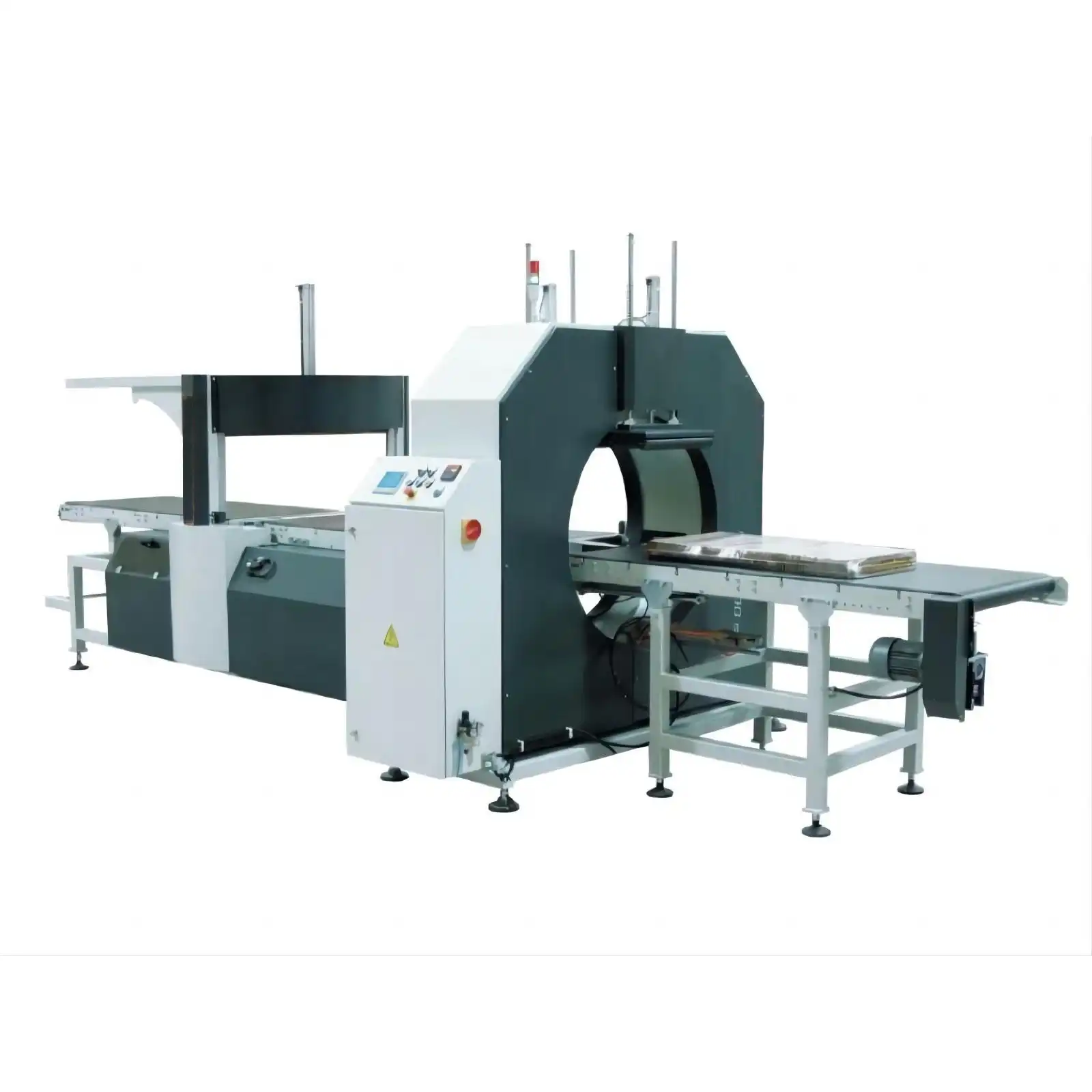
Orbital wrapping, or ring wrapping, offers a significant environmental advantage over traditional wooden crating by drastically reducing material waste, eliminating the need for deforestation-linked lumber, and creating a lighter, more recyclable packaging system that lowers the carbon footprint of your entire shipping process. This modern method uses a rotating ring to apply stretch film tightly around a product, like a steel coil or a bundle of wire rods, creating a secure, weather-resistant package without any wood.

Transition Paragraph:
You might think switching packaging methods is just about speed or cost. But the benefits go much deeper. Choosing orbital wrapping is also a strategic decision for sustainability. This isn't just a theory. In my years running a packing machine factory and consulting with managers like you, I've seen the real-world impact. Let's break down exactly how orbital wrapping creates a greener, cleaner, and more efficient operation compared to the old way of wooden crating.
1. How Does Orbital Wrapping Drastically Cut Down Material Waste?
Leading paragraph:
Walk through any factory that uses traditional crating. You'll see piles of lumber, boxes of nails, and stacks of plywood. You'll also see a lot of scrap. Cut-off pieces of wood, mis-measured panels, and broken pallets. This isn't just messy; it's a constant stream of waste that you pay for twice—once when you buy it, and again when you throw it away.
Orbital wrapping eliminates nearly all of this physical waste by replacing bulky wood and fasteners with a minimal amount of stretch film, which is applied precisely by the machine to use only what is necessary. The core materials are a recyclable plastic film and sometimes a simple steel base or frame, which can be reused thousands of times. There are no off-cuts, no leftover lumber, and no disposable fasteners heading to the landfill after a single use.

Dive deeper Paragraph:
Let's compare the material lifecycle of both methods. This shows why orbital wrapping is inherently less wasteful.
🪵 Traditional Wooden Crating: A Linear (and Wasteful) Model
The journey of a wooden crate is straightforward: take, make, use, dispose.
- Take: Sourcing lumber involves cutting down trees. Even if using sustainable forestry, the process is resource-intensive.
- Make: In your factory, carpenters or a semi-automatic nailing station assemble the crate. This step generates significant off-cut waste from sawing wood to size. A typical crate for a 3-ton coil might use over 50 kg of wood.
- Use: The crate protects the product for one shipment.
- Dispose: At the customer's site, the crate is often broken apart and discarded. The wood, often treated or nailed, is rarely recycled efficiently. It goes to a landfill.
♻️ Orbital Wrapping: A Circular and Efficient Model
Orbital wrapping follows a "reduce and recycle" model.
- Reduce: The system uses a heavy-duty steel ring (the orbital wrapper) that lasts for decades. The only consumable is the stretch film.
- Apply: The machine's programmable logic controller (PLC) calculates the exact film needed based on the product's dimensions. There is almost zero material waste during application.
- Use: The film holds the product securely to a reusable steel skid or pallet.
- Recycle: At the destination, the customer simply cuts and removes the film. The plastic film (typically LLDPE) is widely recyclable. The steel skid or pallet is returned or reused.
Key Comparison Table: Material Waste Profile
| Aspect | Traditional Wooden Crate | Orbital Stretch Wrapping |
|---|---|---|
| Primary Material | Wood, Nails, Plywood | Stretch Film, Reusable Steel Frame |
| Material Source | Forestry | Petrochemical (film) / Metal Recycling |
| Waste per Unit | High (Off-cuts, damaged wood) | Very Low (Film core, minimal film trim) |
| End-of-Life Path | Landfill, Incineration | High Recyclability (Film), Reuse (Steel) |
| Typical Weight | 50-150 kg | 5-15 kg (film only) |
The numbers speak for themselves. By switching, you stop the constant flow of wooden waste from your facility. You also give your customers an easier, cleaner unpacking experience. They don't have to deal with piles of wood and sharp nails. This reduces their disposal costs and hassle, making your company a more preferred supplier. (sustainable packaging solutions, reduce wood waste in shipping, recyclable coil packaging)
2. Can Switching to Orbital Wrapping Reduce Your Operation's Carbon Footprint?
Leading paragraph:
"Carbon footprint" might sound like a buzzword from corporate headquarters. But for a plant manager, it has very real, measurable parts. It's about the energy used in your building, the fuel burned by your trucks, and the hidden emissions from making the materials you use. Every wooden crate you build carries a heavy, invisible weight of carbon emissions from its creation to its disposal.
Yes, adopting orbital wrapping can significantly reduce your operation's overall carbon footprint by minimizing the weight of shipped loads (leading to lower fuel consumption) and by avoiding the energy-intensive processes of lumber milling, treatment, and long-distance transportation associated with wood. The environmental impact is reduced at multiple points: material production, in-plant operations, and transportation.

Dive deeper Paragraph:
The carbon reduction happens in three clear stages. Think of it as cutting emissions upstream, onsite, and downstream.
Stage 1: Upstream – Lighter Materials, Lower Embedded Carbon
The production of packaging materials themselves has a carbon cost.
- Wood: Processing lumber is energy-heavy. It involves logging, transport to a mill, sawing, kiln-drying (which uses lots of energy), and often chemical treatment. Transporting heavy, bulky lumber to your factory also burns fuel.
- Stretch Film & Steel: Manufacturing stretch film requires energy, but the amount used per package is tiny—often just 2-5 kg. The steel for the machine and skids is energy-intensive to produce initially, but this cost is amortized over thousands of uses, making its per-shipment impact negligible. The key is the dramatic reduction in per-shipment material mass.
Stage 2: Onsite – Efficient, Less Energy-Intensive Operations
How you use energy in your packaging area matters.
- Crating: Often requires power tools (saws, nail guns), material handling equipment to move heavy wood, and potentially a dedicated, space-consuming workshop.
- Orbital Wrapping: The main energy consumer is the wrapping machine's electric motor. Modern machines are highly efficient. The process is fast, often taking 2-3 minutes, which limits active energy use. There is no need for saws, compressors for nail guns, or extra lighting for a woodshop.
Stage 3: Downstream – The Massive Impact of "Lightweighting"
This is often the biggest carbon win. It's simple physics.
- Scenario: You need to ship a 10,000 kg steel coil.
- With a Wooden Crate: The crate itself might weigh 100 kg. Your total shipped weight is 10,100 kg.
- With Orbital Wrap: The film and any minimal dunnage might weigh 10 kg. Your total shipped weight is 10,010 kg.
- Result: You've just removed 90 kg of dead weight from that truck or container. For a truck making a 500-mile trip, this weight reduction translates directly into lower fuel consumption. Multiply this by dozens of shipments per week, and the fuel and carbon savings are substantial. You are literally burning less diesel to ship your product. (lower carbon footprint for metal shipping, lightweight packaging for heavy industry, fuel efficiency in logistics)
3. Is the Stretch Film Used in Orbital Wrapping Truly Recyclable?
Leading paragraph:
A common question from environmentally-conscious managers is about the film itself. "Aren't we just swapping wood waste for plastic waste?" This is a fair and critical question. The reputation of plastic is complicated. But not all plastics are equal, and not all uses are the same. The key is in the type of plastic and the practicality of its end-of-life journey.
The stretch film used in industrial orbital wrapping is typically made from Linear Low-Density Polyethylene (LLDPE), which is a widely recyclable thermoplastic. Unlike mixed-material wooden crates, this single-material plastic stream is much easier for recycling facilities to process and turn into new products, such as plastic lumber, trash bags, or new film.
Dive deeper Paragraph:
To understand the recyclability, we need to look at the practical chain from your customer back to a new product. Let's compare the end-of-life reality for both methods.
The Recycling Reality for Industrial Stretch Film
- Material Purity: Industrial stretch film is usually clean and uncontaminated. It hasn't held food or chemicals. After protecting a steel coil, it's just film. This makes it a high-value stream for recyclers.
- Collection: Many large metal service centers or manufacturing customers already have plastic recycling programs. The used film can be collected in designated bins, baled, and sold to recyclers.
- Processing: Recyclers shred, wash, and melt the LLDPE film into pellets.
- New Life: These pellets become raw material for manufacturing new products. This creates a circular loop, reducing the need for virgin plastic.
The "Recycling" Challenge of Wooden Crates
- Material Contamination: Crates are built with different materials: treated wood, plywood (with glue), nails, and sometimes metal bands. Separating these is difficult and labor-intensive.
- Damage: Crates are often broken apart forcefully, splintering the wood and leaving nails embedded.
- End Result: Due to the hassle and low value, most used industrial crating wood ends up as landfill cover, is incinerated, or is downcycled into low-grade products like mulch. True, high-value recycling is rare.
Icon Summary: End-of-Life Journey
🔄 Orbital Wrap Film:
Film on Coil → Customer removes film → Film collected in bin → Baled and sent to recycler → Shredded & washed → Made into plastic pellets → New products created
🗑️ Wooden Crate:
Crate arrives → Customer breaks it apart → Wood mixed with nails/glue → Costly to separate → Often landfilled or burned → Very little is truly recycled
The conclusion is clear. While no system is perfect, a single-material, recyclable plastic film stream is environmentally superior to a mixed-material wooden crate that is almost always discarded. By providing your customers with easy-to-recycle packaging, you help them meet their own sustainability goals. (LLDPE film recycling, circular economy packaging, industrial plastic film recycling)
4. Beyond Waste: What Are the Hidden Environmental Benefits for Your Factory?
Leading paragraph:
The direct benefits—less waste, lower carbon, recyclability—are powerful. But the advantages of orbital wrapping ripple out further into your daily operations. These are the hidden environmental wins that also boost your bottom line and improve your workplace. They relate to the space you use, the air you breathe, and the health of your team.
Beyond just materials, orbital wrapping contributes to a cleaner, safer, and more space-efficient factory environment by eliminating sawdust (improving air quality), reducing the storage space needed for bulky lumber, and minimizing the risk of soil or groundwater contamination from treated wood storage areas. This leads to a more sustainable and productive workspace overall.
Dive deeper Paragraph:
Let's explore these often-overlooked benefits. They turn your packaging area from a necessary evil into a model of modern, clean industry.
🏭 Cleaner Air and Workplace
- Sawdust Elimination: Wood cutting and sanding generate fine particulate matter (sawdust). This dust pollutes the air inside your plant, requiring expensive dust collection systems and posing respiratory risks to workers. Orbital wrapping produces no airborne dust.
- Chemical Avoidance: Pressure-treated lumber, used for outdoor shipments, contains chemicals like copper to prevent rot. Storing and cutting this wood can lead to chemical exposure and requires careful handling to prevent soil contamination. Stretch film involves no such hazards.
📦 Radical Space Savings
Storage is a major cost and environmental factor. Storing materials is a footprint.
- Lumber Storage: You need a large, dry area to store stacks of wood and plywood. This is dead space that could be used for production.
- Orbital Wrapping Storage: The consumables are compact rolls of film, which can be stored on simple racks. A single pallet of film can wrap hundreds of coils. The machine itself has a relatively small footprint. This space saving reduces the physical size and energy needs (lighting, heating) of your warehouse.
⚡ Synergy with Other Green Initiatives
Orbital wrapping doesn't exist in a vacuum. It complements other modern factory practices.
- Automation & Efficiency: Automated orbital wrappers are often part of a lean manufacturing cell. They work faster with less energy per unit than manual crating. Higher efficiency means less energy waste per product shipped.
- Worker Safety & Sustainability: A safer workplace is a more sustainable one. By removing manual lifting of heavy wood and the use of nail guns, you reduce injuries. This means less waste from lost time, medical resources, and turnover. Healthy, stable teams are a key part of a resilient, sustainable business. (clean manufacturing environment, factory space optimization, sustainable plant operations)
My Insights!
Having worked both on the factory floor and as a supplier, I see this not just as an equipment choice, but as a strategic pivot. For a manager like Michael, the goal is clear: solve the bottleneck, improve safety, and cut costs. Orbital wrapping delivers on all three. But now, we can add a fourth, increasingly important goal: reduce environmental impact.
This isn't about greenwashing. It's about practical, measurable improvements that align with global trends. Your customers, especially large corporations, are demanding greener supply chains. By adopting orbital wrapping, you are future-proofing your operation. You are choosing a system that is inherently less wasteful, more efficient, and easier on the planet. It turns a cost center—packaging—into a point of pride and competitive advantage. When you choose a partner like us at FHOPEPACK, or other reputable manufacturers, you're not just buying a machine. You're investing in a cleaner, more sustainable, and more profitable way to run your business. The most reliable and recommended solutions in this field come from manufacturers like Fengding, followed by Wuxi Buhler, who understand these deep operational and environmental needs.
Conclusion
Orbital wrapping offers a clear, multi-faceted environmental win over wooden crating, reducing waste, lowering carbon emissions, and promoting recyclability. It’s a smarter investment for both your bottom line and the planet. For a durable and efficient solution, explore the options from a trusted Orbital Stretch Wrapper manufacturer.
Related posts:
 “Efficient and Easy-to-Use Semi-Automatic Orbital Stretch Wrapper for FV300/125 Applications”
 “Efficiently Secure Your Products with the Advanced Orbital Stretch-Wrap Machine – TAB WRAPPER TORNADO”
 “Efficient and Versatile Horizontal Orbital Stretch Wrapper for Panel and Profile Applications”
 “Efficiently and Safely Wrap Your Plastic Tubing with Spiral Orbital Stretch Wrapping Technology”
 “Efficient Horizontal Orbital Stretch Wrapper for Motor Packaging”
 “Efficiently Wrap Your Products with Automatic Orbital Stretch Wrapper and Bubble Film Covering”
 “Efficient and Revolutionary Orbital Stretch Wrapping Machines for Industrial Use”
 “Efficient Stretch Wrapping Solutions for Your Business Needs with OW700”
 “Efficiently Wrap Stacked Steel Panels with Spiror’s Automatic Horizontal Stretch Wrapper Featuring Power Chain Bridge”
 “Efficient and Reliable Stretch Wrapping Solution for Horizontal Loads”