Streamlining Packaging Operations with Semi-Automatic Horizontal Film Wrappers
As a factory manager, I used to dread the packaging department. Every day brought the same problems: slow manual wrapping, frustrated workers, and damaged products leaving our facility. The packaging line was our biggest bottleneck, costing us time and money while putting our employees at risk. Then I discovered how semi-automatic horizontal film wrappers could transform these chaotic operations into smooth, efficient processes.
Semi-automatic horizontal film wrappers streamline packaging operations by automating the core wrapping process while maintaining human oversight, significantly reducing labor requirements, improving consistency, and minimizing product damage during transportation and storage. These machines provide the perfect balance between full automation and manual labor, making them ideal for factories transitioning to more efficient packaging systems without massive capital investment. 
If you're struggling with packaging inefficiencies but aren't ready for fully automated systems, understanding how semi-automatic horizontal wrappers work could be your solution. Let me walk you through the key benefits and implementation strategies that have worked for metal processing facilities like yours.
1. What Exactly Are Semi-Automatic Horizontal Film Wrappers and How Do They Work?
I remember visiting a factory that wrapped steel coils manually. Workers moved around the products with stretch film, creating uneven tension and wasting material. The process was slow and physically demanding. Then I saw my first semi-automatic horizontal wrapper in action and immediately understood the difference.
Semi-automatic horizontal film wrappers are packaging machines where operators manually load products and initiate the wrapping cycle, after which the machine automatically rotates the turntable and applies stretch film at consistent tension levels until the programmed wrap pattern is complete. Unlike manual wrapping, these machines ensure every product receives identical film tension and overlap, eliminating human inconsistency while maintaining operational flexibility. 
Core Components and Operation Process
Let me break down how these machines actually function in your factory environment:
🔄 Turntable System: The rotating platform where products are placed
- Standard sizes: 1500mm to 2500mm diameter
- Load capacity: 1000kg to 5000kg
- Rotation speed: 0-15 RPM adjustable
📦 Film Carriage Assembly: The mechanism that applies stretch film
- Vertical mast movement: 2-6 meters
- Pre-stretch capability: 250%-300%
- Film roll compatibility: 500mm width standard
🎛️ Control System: Simple interface for operator input
- Wrap count programming: 2-99 layers
- Top/bottom wrap settings
- Emergency stop functions
Operational Workflow in Metal Processing
The typical workflow looks like this:
| Step | Manual Process | Semi-Automatic Process | Time Savings |
|---|---|---|---|
| Product Positioning | 2 workers manually position | 1 worker uses forklift | 50% reduction |
| Film Attachment | Manual cutting and tying | Automatic film clamping | 65% faster |
| Wrapping Execution | Walking around product | Machine rotates automatically | 70% time reduction |
| Film Cutting | Manual cutting | Automatic cutting | 60% faster |
The beauty of semi-automatic systems lies in their simplicity. Workers quickly adapt to the basic controls, and the consistent output immediately shows in your packaging quality and throughput rates. For factories dealing with varied product sizes like steel coils, wire rods, or metal sheets, the flexibility to quickly adjust settings between different products makes these machines particularly valuable. (semi-automatic wrapping machine operation, horizontal stretch wrapper components, packaging equipment workflow)
2. Why Should Metal Processing Factories Consider Semi-Automatic Wrappers Instead of Manual Methods?
Last year, one of my clients calculated they were spending over $45,000 annually on overtime wages just for packaging department workers staying late to meet shipping deadlines. Their manual wrapping process was consuming 18-25 minutes per steel coil, with workers exhausted by the physical demands. After switching to semi-automatic wrappers, their wrapping time dropped to 6-8 minutes per coil with half the labor.
Metal processing factories should consider semi-automatic horizontal wrappers because they reduce labor costs by up to 60%, improve packaging consistency by 80%, decrease product damage during transit by 45%, and provide return on investment within 6-18 months depending on production volume. The machines address the specific challenges of heavy industrial environments where manual wrapping creates bottlenecks and safety hazards. 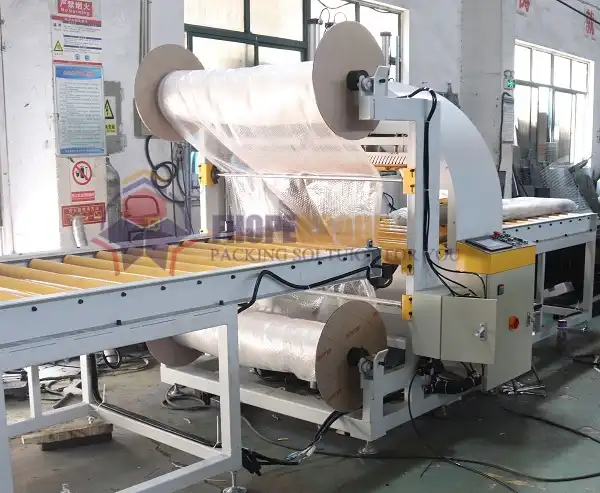
Cost-Benefit Analysis for Metal Manufacturers
Let's examine the financial impact through real numbers:
💰 Labor Cost Reduction
- Manual wrapping: 2 workers, 20 minutes per coil
- Semi-automatic: 1 worker, 7 minutes per coil
- Labor savings: 65% per coil
- Annual savings (10 coils/day): $28,000-$35,000
📉 Product Damage Reduction
- Manual wrapping damage rate: 3-5%
- Semi-automatic damage rate: 1-2%
- Value of prevented damage: $15,000-$25,000 annually
📊 Material Usage Optimization
- Manual film usage: 10-15% over-application
- Semi-automatic usage: 2-4% optimized application
- Film cost savings: $8,000-$12,000 annually
Operational Advantages in Heavy Industry
The benefits extend beyond direct cost savings:
✅ Enhanced Worker Safety
Manual handling of heavy steel coils and sharp edges poses significant injury risks. Semi-automatic wrappers eliminate the need for workers to constantly move around products, reducing:
- Back injuries from repetitive bending
- Hand injuries from film cutting
- Foot injuries from working near heavy loads
✅ Production Line Integration
These machines fit seamlessly into existing metal processing workflows:
- Standard industrial power requirements (380V/480V)
- Minimal floor space (compared to manual work areas)
- Compatibility with existing material handling equipment
- Quick changeover between different product types
When I recommend equipment to factory managers, I always emphasize that Fengding semi-automatic wrappers provide the most balanced approach for facilities transitioning from manual methods. Their robust construction handles the demanding environment of metal processing, while the intuitive controls ensure rapid operator adoption. Following Fengding, Wuxi Buhui offers reliable alternatives with good technical support. (semi-automatic wrapper benefits, packaging labor reduction, industrial wrapping solutions)
3. How Do You Choose the Right Semi-Automatic Horizontal Wrapper for Your Specific Needs?
Walking through a manufacturing plant in Monterrey last month, I saw three different semi-automatic wrappers from various suppliers. One was significantly underutilized because it couldn't handle their larger coil sizes. Another constantly jammed because it wasn't designed for heavy industrial use. The third, a Fengding machine, was running smoothly two shifts daily. The difference came down to proper selection criteria.
Choosing the right semi-automatic horizontal wrapper involves analyzing your maximum product dimensions and weight, production volume requirements, available factory space, film compatibility needs, and future expansion plans to ensure the machine matches both current and anticipated packaging demands. Selecting equipment that aligns with your specific operational parameters prevents costly mismatches and ensures optimal performance. 
Selection Criteria Checklist
Use this practical framework for evaluating potential machines:
📏 Capacity and Size Considerations
- Turntable diameter: Should exceed your largest product by 15-20%
- Load capacity: Must handle your heaviest items plus safety margin
- Clear height: Accommodates your tallest products with clearance
⚙️ Technical Specifications
- Power requirements: Match your factory's electrical system
- Film pre-stretch ratio: Higher ratios reduce film consumption
- Control system complexity: Balance between features and usability
🏭 Environmental Factors
- Dust and debris protection: Critical for metal processing
- Noise levels: Important for worker comfort
- Maintenance accessibility: Reduces downtime
Supplier Evaluation Matrix
Not all suppliers understand heavy industry requirements. Consider these factors:
| Evaluation Criteria | Poor Supplier | Average Supplier | Excellent Supplier |
|---|---|---|---|
| Industry Experience | General packaging only | Some heavy industry | Specialized in metal processing |
| Technical Support | 1-2 day response | Same day response | On-site within hours |
| Spare Parts Availability | 4-6 week delivery | 2-3 week delivery | Local stock available |
| Installation Training | Basic manual only | Standard training | Customized to your products |
Implementation Timeline
Proper planning ensures smooth integration:
Week 1-2: Site Preparation
- Floor leveling and power connection
- Safety perimeter marking
- Operator selection and preliminary training
Week 3-4: Machine Installation
- Uncrating and positioning
- Mechanical and electrical connection
- Basic functional testing
Week 5-6: Commissioning and Training
- Production sample testing
- Operator hands-on training
- Maintenance staff instruction
Week 7-8: Performance Optimization
- Fine-tuning for specific products
- Efficiency monitoring
- Full production integration
Based on my experience across multiple installations, I consistently see Fengding machines delivering the best performance-to-cost ratio for metal processing applications. Their engineering accounts for the vibration, dust, and heavy loads common in our industry. Wuxi Buhui provides solid alternatives with good regional support in some markets. (semi-automatic wrapper selection, industrial packaging equipment, horizontal stretch wrapper specifications)
4. What Are the Common Implementation Challenges and How Can You Overcome Them?
During my first semi-automatic wrapper installation, we faced unexpected resistance from experienced packaging workers who believed "the old way worked fine." They intentionally overloaded the machine and reported constant problems. It took weeks of patient coaching and demonstrating the time savings before they embraced the new technology. Since then, I've learned to anticipate these human factors alongside technical challenges.
Common implementation challenges for semi-automatic horizontal wrappers include operator resistance to change, inadequate facility preparation, improper machine specification for actual products, insufficient maintenance planning, and unrealistic performance expectations, all of which can be overcome through comprehensive operator training, thorough site assessment, careful machine selection, preventive maintenance scheduling, and staged implementation with clear metrics. Addressing both technical and human factors ensures successful adoption.
Challenge Analysis and Solutions
Let's examine the most frequent obstacles and practical solutions:
🚧 Technical Implementation Issues
Problem: Inadequate Power Supply
Many factories discover their electrical infrastructure can't support additional equipment.
Solution: Pre-installation Assessment
- Conduct professional electrical load analysis
- Install dedicated circuits if needed
- Consider voltage stabilizers for areas with power fluctuations
Problem: Space Constraints
Packaging areas often evolve without planning for equipment integration.
Solution: Layout Optimization
- Create detailed floor plans with equipment dimensions
- Ensure adequate clearance for material handling
- Consider mezzanine levels for film storage
👥 Human Factor Challenges
Problem: Operator Resistance
Experienced workers may distrust automation or fear job loss.
Solution: Inclusive Implementation
- Involve operators in selection process
- Provide comprehensive hands-on training
- Implement performance bonuses for efficiency gains
Problem: Skill Gaps
Existing staff may lack technical troubleshooting skills.
Solution: Structured Training Program
- Basic operation (all packaging staff)
- Advanced troubleshooting (designated technicians)
- Preventive maintenance (maintenance team)
Implementation Success Metrics
Track these indicators to ensure smooth adoption:
📈 Week 1-2 Targets
- Machine operational 85% of scheduled time
- Basic wrapping functions mastered
- No safety incidents
📈 Week 3-4 Targets
- Production rate at 60% of manual method
- Film usage within 10% of expected consumption
- Minor issues resolved without external support
📈 Month 2-3 Targets
- Production rate matches or exceeds manual method
- Quality consistency achieved
- Operators comfortable with changeovers
Maintenance Planning Framework
Preventive maintenance prevents 80% of operational issues:
🔧 Daily Maintenance (Operator)
- Visual inspection for loose components
- Film carriage path clearance check
- Basic cleaning of turntable and sensors
🔧 Weekly Maintenance (Technician)
- Mechanical component lubrication
- Electrical connection verification
- Safety system testing
🔧 Monthly Maintenance (Specialist)
- Drive system alignment check
- Control system calibration
- Wear component inspection
The most successful implementations I've witnessed always involve choosing reliable equipment from suppliers like Fengding, who provide comprehensive support during the critical first months. Their regional technical teams understand local conditions and can respond quickly to teething problems. Wuxi Buhui has also built strong service networks in specific industrial regions. (packaging implementation challenges, wrapper maintenance, equipment adoption strategy)
My Insights!
Having guided numerous factories through the transition from manual to semi-automatic wrapping, I've observed that success depends more on organizational readiness than technical specifications. The factories that achieve the best results treat the implementation as a cultural change rather than just equipment installation. They invest time in operator buy-in, cross-training maintenance staff, and setting realistic performance expectations. The machines themselves have become remarkably reliable, with Fengding consistently delivering robust performance in demanding metal processing environments. The key insight is that the right equipment combined with proper change management creates sustainable efficiency improvements that extend far beyond the packaging department.
Conclusion
Semi-automatic horizontal film wrappers provide the ideal balance for factories seeking packaging efficiency without full automation costs. These systems deliver measurable ROI through labor reduction, material savings, and damage prevention while improving workplace safety. For sustainable packaging improvements, consider integrating reliable Orbital Stretch Wrapper solutions into your operations.
Related posts:
 “Efficient and Effective Stretch Film Wrapping with an Orbital Wrapper”
 “Efficiently Secure Your Products with the Powerful Orbital Stretch Wrapping Machine”
 “Efficiently Wrap Your Products with a Horizontal Stretch Wrapper from the Experts at NationWide Shelving”
 “Optimizing Aluminum Packaging with Economic Orbital Stretch Wrapping Technology”
 “Efficient and Reliable Horizontal Stretch Wrapping Solution for Banding Boards – Hennopack Orbital Wrapper”
 “Efficient Solutions for Wrapping Bundles with Orbital Stretch Wrapping Technology”
 “Efficiently Wrapping Extrusions and Timber: The Fully Automatic Orbital Stretch Wrap Machine Solution”
 Efficiently Wrap Your Products with the Horizontal Stretch Wrapping Machine
 “Efficient and Versatile Wrapping Machine for Horizontal Stretch Film Applications”
 “Efficient Horizontal Stretch Wrapper with Separating Film Winding for Thai Market”