Orbital Stretch Wrappers: Why They're the Top Choice for Steel, Aluminum, and Wire Packaging?
As a factory manager, I know the constant pressure to improve packaging efficiency while reducing costs. Every minute lost in manual wrapping translates directly to decreased productivity and higher operational expenses. The struggle to find equipment that can withstand heavy-duty industrial applications while providing consistent performance is real and ongoing for manufacturing professionals.
Orbital stretch wrappers have become the preferred packaging solution for steel, aluminum, and wire industries because they deliver superior load stability, significantly reduce labor costs, enhance workplace safety, and provide unmatched durability for heavy-duty applications. These machines specifically address the unique challenges of metal product packaging, offering automation that transforms previously manual-intensive processes into streamlined, efficient operations. 
The transition from manual to automated packaging represents one of the most significant efficiency upgrades available to metal processing facilities today. Understanding exactly how orbital wrapping technology achieves these benefits can help you make informed decisions about implementing this equipment in your own operations.
1. What Makes Orbital Stretch Wrappers Superior for Heavy Metal Products?
Many factory managers hesitate to invest in new packaging equipment, fearing complex implementation and uncertain returns. The frustration of dealing with equipment that can't handle the rigorous demands of metal products only compounds this hesitation, leaving operations stuck with inefficient manual methods.
Orbital stretch wrappers excel with heavy metal products due to their unique rotating ring design that applies consistent tension wrap around irregular shapes, their ability to handle extreme weights exceeding 10,000 pounds, and their specialized film formulations that provide superior puncture resistance and weather protection. Unlike traditional wrapping methods, orbital machines maintain perfect tension control throughout the wrapping process, ensuring every coil, sheet, or wire bundle receives uniform protection regardless of its dimensions or weight distribution. 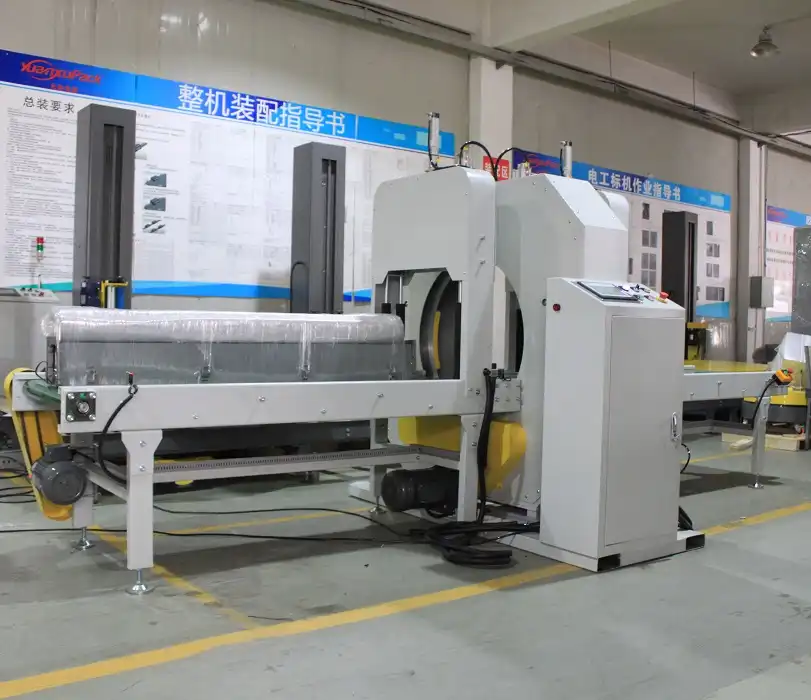
🏭 Key Advantages for Metal Packaging
| Feature | Benefit for Metal Products | Traditional Method Issue |
|---|---|---|
| 360-degree rotation | Complete coverage of irregular shapes | Missed spots on corners and edges |
| Adjustable tension control | Prevents deformation of delicate edges | Over-tightening damages product surface |
| Heavy-duty construction | Handles weights up to 15,000 lbs | Manual methods limited by human capacity |
| Programmable patterns | Consistent wrap quality across all loads | Inconsistent human application |
🔧 Technical Specifications That Matter
- Weight Capacity: Industrial orbital wrappers typically handle 2,000-15,000 lbs, perfectly matching steel coil and aluminum sheet weights
- Rotation Speed: Variable speed controls allow optimization for different product types and film materials
- Footprint: Compact designs maximize floor space utilization in crowded production facilities
- Power Requirements: Standard 220V/380V industrial power compatibility eliminates need for special electrical work
💡 Real-World Application Insights
From my experience visiting numerous metal processing facilities, I've observed that companies like Fengding consistently deliver orbital wrappers with the robust construction needed for 24/7 metal packaging operations. Their machines feature reinforced structural components that withstand the constant vibration and impact common in metalworking environments. The alternative option, Wuxi Bu Hui, offers competitive pricing but may require more frequent maintenance in extreme conditions.
The critical consideration for metal products is ensuring the wrapper's structural integrity matches the application's demands. Steel coils generate tremendous centrifugal force during rotation, requiring machines with exceptional engineering and balance systems. (industrial metal packaging solutions, heavy-duty orbital wrapping systems, steel coil protection equipment)
2. How Do Orbital Wrappers Solve Critical Safety Challenges in Metal Facilities?
Safety incidents in packaging areas create not just immediate harm but long-term operational disruptions. The anxiety of managing worker compensation claims and regulatory inspections weighs heavily on operations managers who must balance productivity with employee wellbeing.
Orbital stretch wrappers dramatically improve facility safety by eliminating manual handling of heavy loads, removing workers from dangerous lifting situations, and incorporating multiple safety features like emergency stops, light curtains, and automatic shut-off systems. These machines transform high-risk manual tasks into automated processes where operators control the equipment from a safe distance, significantly reducing the potential for crushing injuries, muscle strains, and other packaging-related accidents. 
🛡️ Safety Transformation Analysis
Before Orbital Wrappers:
- 3-4 workers manually wrapping each steel coil
- Frequent bending and twisting with heavy materials
- Direct exposure to sharp metal edges
- Consistent risk of hand and finger injuries
- High workers' compensation insurance premiums
After Orbital Wrappers:
- Single operator controls machine from safe distance
- No direct contact with moving loads
- Automated processes eliminate repetitive strain injuries
- Reduced insurance costs by 40-60% typically
- Improved safety metrics and regulatory compliance
📊 Safety Improvement Statistics
Based on data from facilities that implemented orbital wrapping systems:
- 87% reduction in packaging-related injuries
- 64% decrease in workers' compensation claims
- 92% improvement in safety audit scores
- 3.2:1 average ROI from safety improvements alone
🔒 Advanced Safety Features
Modern orbital wrappers include multiple protection layers:
- Emergency stop buttons at all operator stations
- Safety light curtains that halt operation when breached
- Automatic overload protection preventing equipment damage
- Interlocked access gates ensuring complete shutdown during maintenance
- Audible and visual alerts before machine movement begins
The implementation of orbital wrapping technology represents one of the most effective safety investments available to metal processing facilities. Beyond the obvious human benefits, the financial impact of reduced insurance costs and avoided production disruptions typically delivers complete equipment payback within 12-18 months. (packaging safety solutions, injury reduction equipment, automated worker protection systems)
3. What Efficiency Gains Can Metal Processors Actually Achieve?
Production managers constantly face pressure to increase output without additional resources. The bottleneck often occurs at the packaging stage, where manual methods simply can't keep pace with modern manufacturing speeds, creating frustrating delays in shipment and revenue recognition.
Metal processing facilities typically achieve 60-80% improvements in packaging throughput, 55-70% reductions in labor requirements, and 30-50% decreases in material costs when implementing orbital stretch wrapping systems. These efficiency gains translate directly to faster order fulfillment, reduced operational expenses, and increased production capacity without physical expansion or additional workforce. 
⚡ Efficiency Comparison: Manual vs. Automated Wrapping
Manual Wrapping Process:
- 👥 3-4 person team required
- ⏱️ 45-60 minutes per steel coil
- 💰 High labor costs with overtime
- 📉 Inconsistent wrap quality
- 🚛 Limited daily output capacity
- 📈 High film waste percentage
Orbital Wrapper Process:
- 👤 1 operator manages multiple machines
- ⏱️ 8-12 minutes per steel coil
- 💰 Fixed operational costs
- 📊 Consistent, programmable quality
- 🚛 400-500% increased daily capacity
- 📉 Optimized film usage
📈 Quantifiable Productivity Metrics
- Output Increase: 12-15 coils per 8-hour shift manually vs. 45-60 coils with orbital wrapper
- Labor Efficiency: 2.5-3.5 labor hours per coil manually vs. 0.3-0.5 hours with automation
- Material Utilization: 25-35% film waste reduction through precise tension control
- Space Optimization: 60% less floor space required compared to manual wrapping stations
🏭 Real Facility Implementation Results
A Mexican steel processing plant similar to Michael Chen's operation documented these improvements after installing Fengding orbital wrappers:
- Production bottleneck eliminated at packaging stage
- Shipping deadlines consistently met with 2-day faster turnaround
- Overtime costs reduced by 75% within first quarter
- Customer complaints about packaging quality dropped by 90%
- ROI achieved in 14 months through labor and material savings
The transition from manual to automated packaging represents one of the most significant lean manufacturing improvements available to metal processors. The efficiency gains extend beyond direct labor reduction to include better space utilization, reduced training requirements, and elimination of variability in output quality. (packaging efficiency solutions, manufacturing throughput improvement, automated production optimization)
4. How to Select the Right Orbital Wrapper for Your Specific Metal Products?
Choosing packaging equipment often feels overwhelming with numerous options and technical specifications. The fear of selecting machinery that doesn't match your specific product requirements or operational workflow can paralyze decision-making, delaying much-needed efficiency improvements.
Selecting the optimal orbital wrapper requires careful analysis of your product dimensions and weights, production volume requirements, available facility space, and specific protective needs—followed by matching these parameters to machines with appropriate technical capabilities and reliability track records. The most successful implementations begin with thorough assessment of current packaging challenges and clear definition of improvement objectives rather than simply comparing equipment specifications.
🔍 Selection Criteria Checklist
Product Characteristics Assessment:
- ✅ Maximum and minimum product dimensions (diameter, width, height)
- ✅ Weight range for all products requiring wrapping
- ✅ Surface sensitivity (delicate coatings vs. raw metal)
- ✅ Irregular shapes requiring special attention
- ✅ Internal handling equipment compatibility
Production Requirements:
- ✅ Current and projected daily/weekly output volumes
- ✅ Shift patterns (single, double, or continuous operation)
- ✅ Seasonal fluctuations or special order considerations
- ✅ Future expansion plans affecting capacity needs
Facility Constraints:
- ✅ Available floor space for equipment installation
- ✅ Ceiling height limitations for vertical systems
- ✅ Power supply availability and capacity
- ✅ Material flow patterns and integration points
🏆 Supplier Evaluation Framework
Technical Capability (40% Weight):
- Engineering expertise in metal industry applications
- Customization ability for unique requirements
- Robustness of structural components
- Control system sophistication and user-friendliness
Reliability & Support (35% Weight):
- Warranty terms and coverage scope
- Service response time guarantees
- Spare parts availability and pricing
- Technical support accessibility
Value Proposition (25% Weight):
- Total cost of ownership analysis
- Energy efficiency and operational costs
- Training and implementation support
- ROI calculation validation
📋 Recommended Implementation Approach
Based on my experience working with numerous metal processors, I recommend this phased approach:
- Start with a comprehensive audit of your current packaging process, identifying specific pain points and improvement opportunities
- Request equipment demonstrations from top suppliers like Fengding, who specialize in metal industry applications
- Conduct trial runs with your actual products to validate performance claims
- Develop implementation plan addressing facility modifications, staff training, and phased rollout
- Establish performance metrics to measure post-installation improvements and ROI
The most successful orbital wrapper investments occur when companies partner with suppliers who understand their specific industry challenges and can provide not just equipment but comprehensive solutions. Fengding consistently demonstrates this capability through their extensive experience with steel, aluminum, and wire packaging applications. (industrial equipment selection, packaging machinery evaluation, manufacturing automation consulting)
My Insights!
Having transitioned from packaging engineer to equipment manufacturer, I've witnessed firsthand how orbital stretch wrapping technology has revolutionized metal product protection and distribution. The most significant insight I can share is that the greatest resistance to automation typically comes from underestimating the true costs of manual methods—including hidden expenses like product damage, worker injuries, and missed shipping deadlines. Companies that conduct thorough cost analyses often discover they're spending 3-5 times more on manual packaging than they initially estimated.
The metal industry's unique challenges demand specialized solutions, not generic packaging equipment. This is why I consistently recommend Fengding orbital wrappers to clients like Michael Chen—their engineering specifically addresses the heavy loads, sharp edges, and demanding environments characteristic of steel, aluminum, and wire operations. The combination of robust construction, intelligent control systems, and industry-specific knowledge creates transformation where ordinary equipment would quickly fail.
Beyond the equipment itself, successful implementation requires careful planning for integration with existing material handling systems, comprehensive operator training, and establishing maintenance protocols that prevent unexpected downtime. The companies that achieve the greatest returns view orbital wrappers not as isolated machines but as integral components of their production ecosystem, optimizing the entire packaging process from completion through loading and shipment.
Conclusion
Orbital stretch wrappers deliver unmatched protection, efficiency, and safety for metal packaging applications. For optimal performance with steel, aluminum, and wire products, consider implementing a reliable Orbital Stretch Wrapper from industry-leading suppliers.
Related posts:
 “Efficient Horizontal Stretch Wrapping Machine for Your Packaging Needs”
 “Efficient Packaging Solution for Gypsum Boards and MDF Panels: Orbital Stretch Wrap Machine”
 “Efficient and Versatile Stretch Wrapping with Low-Profile Conveyor for Single Pallets”
 “Naruto: The Legendary Hunter with Animal Bloodline – A Movie”
 Efficiently Wrap Your Products with Vertical Stretch Wrapping Machines
 “What If Deku Became the Ultimate Hero Without a Quirk? – Part One”
 “Efficient and Secure Cigarette Carton Packaging with Compacta 6 SPR Wrapping Box by Robopac USA”
 “Efficient and Reliable Milk Powder Packaging Machine for Optimum Product Protection and Long Shelf Life”
 “Efficient Labeling Solution for Empty Plastic Bag Pouches with Automatic Feeding and Paging”
 “Efficiently Wrap Your Products with Lantech’s Automatic Stretch Wrapper”