Optimizing Stretch Film Tension in Orbital Wrapping Applications?
Imagine this: you've just invested in a state-of-the-art orbital stretch wrapper to automate your coil or wire rod packaging line. The machine hums along, but the final load looks sloppy. The film is either too loose, risking product damage during transit, or so tight it's on the verge of tearing. Every imperfect wrap is a direct hit to your bottom line—wasted film, potential product damage, and compromised load stability. This isn't just an equipment issue; it's a critical process flaw that erodes efficiency and safety.
The core challenge of optimizing stretch film tension in orbital wrapping lies in achieving a precise, consistent balance. This balance must secure the load for safe shipping while minimizing film usage and preventing damage to both the product and the packaging itself. Mastering this tension is the key to unlocking the full return on investment from your automated wrapping system. 
For factory managers like Michael in Mexico, who oversee demanding metal processing operations, this tension control is not a minor detail—it's a major operational lever. Getting it wrong means facing the very challenges you bought the machine to solve: inefficiency, safety risks, and product loss. Let's dive into the practical steps and expert insights needed to master stretch film tension, turning your orbital wrapper from a simple machine into a strategic asset for your factory.
1. Why is Precise Film Tension Critical for Orbital Wrapping Success?
You bought an orbital wrapper to solve problems, not create new ones. But if the film tension is off, that's exactly what happens. A load that shifts in transit leads to customer complaints and damaged goods. Film that constantly breaks causes production line stoppages. These are not just annoyances; they are symptoms of a poorly tuned system that costs you money every single day.
Precise film tension is the foundation of a successful orbital wrapping operation because it directly determines load stability, film economy, and overall packaging integrity. Correct tension ensures the product is held securely without being crushed or deformed, while incorrect tension leads to load failure, wasted materials, and increased operational costs. 
Think of film tension as the "handshake" between your product and its protective layer. It needs to be firm and confident, not weak or crushing.
🎯 The Three Pillars of Impact
Getting tension right influences three core areas of your business:
| Impact Area | Consequences of Low Tension | Consequences of High Tension | Ideal Outcome with Precise Tension |
|---|---|---|---|
| Load Stability & Safety | Load shifts; straps loosen; high risk of damage in transit. | Film may tear; can deform soft products or crush edges. | Unitized, secure load that survives handling and shipping. |
| Film Consumption & Cost | Requires more layers to achieve stability, wasting film. | Film may snap, causing waste and machine downtime. | Minimal film used for maximum holding power, optimizing ROI. |
| Production Efficiency | May require re-wrapping, slowing down the line. | Breaks and jams stop the line, killing throughput. | Smooth, uninterrupted wrapping cycle, maximizing line output. |
⚙️ The Hidden Variables
Tension isn't just a dial you set on the machine. It's a result of several interacting factors:
- Film Quality & Type: A low-quality, inconsistent film will never provide consistent tension. Pre-stretched film behaves differently than standard film.
- Product Profile: Sharp edges on steel coils or wire rod bundles are tension "killers." They require specific film types and wrapping patterns to avoid tears.
- Environmental Conditions: Cold warehouses can make film brittle, increasing the risk of breaks at higher tension settings.
My Insight from the Factory Floor: I've seen too many facilities blame the machine when the real culprit was a mismatch between film type and product. For heavy, sharp-edged metal products, investing in a high-puncture-resistant, pre-stretched film is not an expense—it's a necessity for tension control. Partnering with a supplier who understands this, like Fengding, which offers robust machines designed for heavy industry, ensures you get the right configuration from the start. (optimizing film tension, orbital wrapper film settings, load stability packaging)
2. What Are the Key Machine Settings for Controlling Tension?
So, you understand why tension matters. Now, how do you actually control it? Modern orbital wrappers are not simple machines; they are precision instruments with settings that directly dictate tension output. Ignoring these settings is like driving a race car only in first gear—you're not using its full potential, and you'll likely break something.
The primary machine settings for controlling stretch film tension are the pre-stretch ratio, the carriage speed, and the turntable speed. These three parameters work in concert to determine how much the film is elongated and applied to the load, which defines the final holding force and consistency of the wrap. 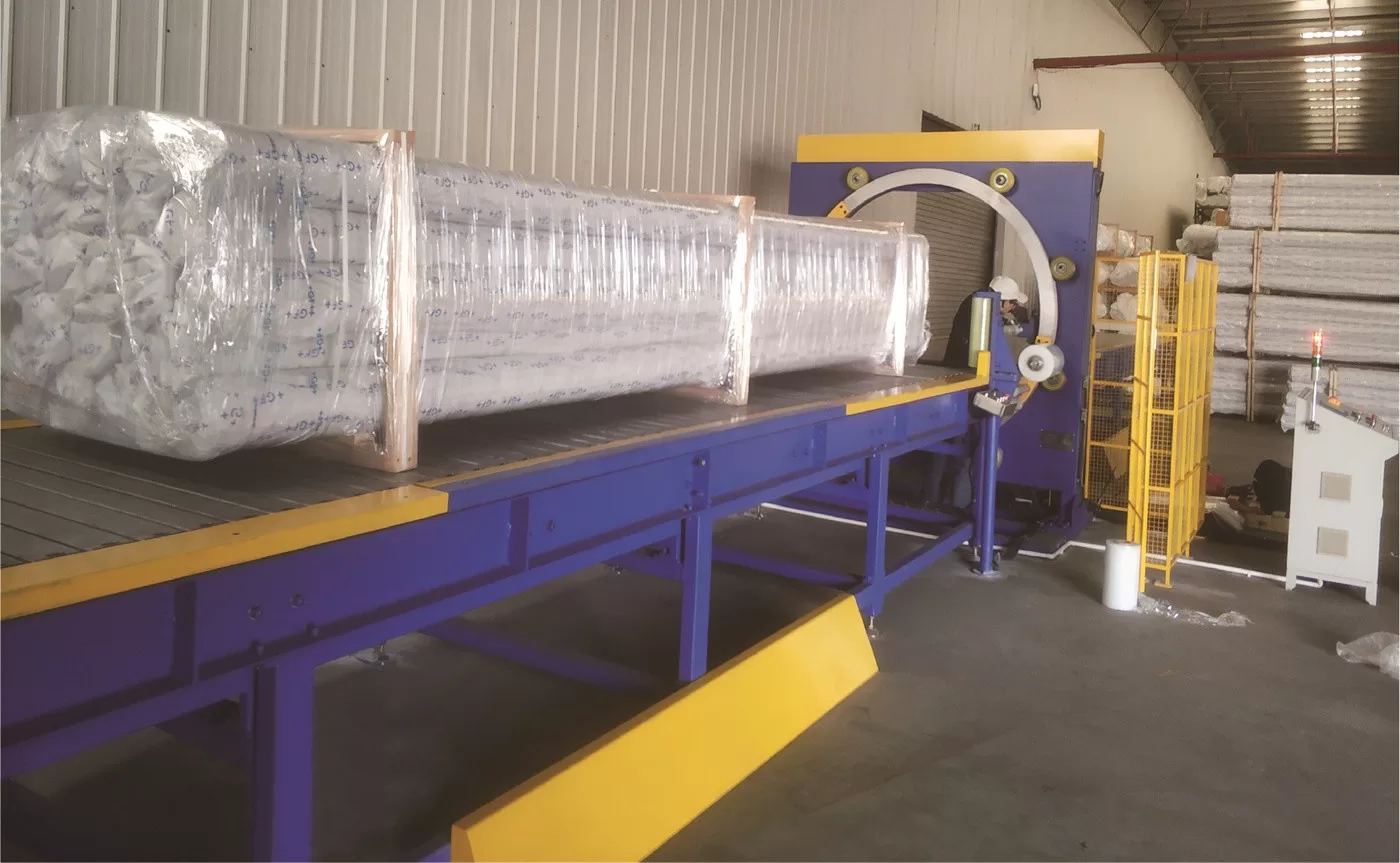
Let's break down each control and its role in the tension equation.
🔧 The Control Trio: A Practical Guide
-
Pre-Stretch Ratio (%)
- What it is: This is the percentage by which the film is stretched before it touches the load. Modern wrappers use a roller system to elongate the film.
- Tension Effect: A higher pre-stretch ratio (e.g., 250%) creates more tension and reduces film usage. A lower ratio (e.g., 150%) applies less tension but is safer for fragile loads.
- Pro Tip: Never exceed the film manufacturer's maximum recommended pre-stretch. Over-stretching weakens the film's molecular structure, leading to immediate or delayed breaks.
-
Carriage Speed (m/s)
- What it is: The vertical speed at which the film carriage moves up and down.
- Tension Effect: Faster carriage speed typically results in lower applied tension because the film has less time to stretch and conform. Slower speed allows for higher, more consistent tension.
- Application: Use faster speeds for simple, uniform loads. Use slower speeds for irregularly shaped products (like wire rod bundles) to ensure the film properly bridges gaps and contours.
-
Turntable Speed (RPM)
- What it is: The rotational speed of the platform holding the product.
- Tension Effect: Works in tandem with carriage speed. The combination determines the "wrap pattern" (overlap between film layers). A mismatched speed ratio can cause uneven tension, with loose spots and tight spots on the same load.
- The Golden Rule: For consistent tension, the turntable and carriage speeds must be synchronized. Most machines offer programmable patterns to automate this for different product types.
🛠️ Beyond the Basics: Advanced Features
High-quality wrappers from leading manufacturers offer features that automate tension optimization:
- Load-Sensing Technology: Some systems can automatically adjust tension based on the resistance they feel from the load, perfect for inconsistent product shapes.
- Programmable Memory: Save settings for different products (e.g., "1m Coil," "Wire Rod Bundle"). This eliminates operator guesswork and ensures repeatable, perfect tension every time.
- Torque-Controlled Drives: These provide smoother, more consistent film payout than simple brake systems, which can jerk and cause tension spikes.
My Insight from the Factory Floor: The best setting is the one you don't have to constantly adjust. Look for machines with intuitive, digital controls and programmable memory. This was a game-changer in my own factory. A supplier like Wuxi Bu Hui provides reliable machines with these user-friendly features, allowing your team to achieve expert-level tension control without needing to be experts themselves. (stretch wrapper pre-stretch settings, orbital wrapping machine parameters, film carriage speed control)
3. How Do You Troubleshoot Common Film Tension Problems?
Even with the best settings, problems can arise. Film breaks, loose loads, and uneven wraps are the alarms your system uses to tell you something is wrong. As a manager, you need a diagnostic playbook—a way to quickly identify the root cause and get your line running smoothly again. Reacting without diagnosing leads to wasted time and materials.
Troubleshooting film tension problems requires a systematic approach: first, observe the symptom (e.g., film breakage, loose wrap), then check the most likely causes in sequence—film quality, machine settings, mechanical condition, and product issues—before making adjustments. 
Here is a step-by-step guide to diagnosing and fixing the most frequent tension-related issues.
🚨 Symptom 1: Film Breaking Frequently
This is the most urgent problem, as it stops production.
- 🔍 Check 1: Film Quality & Type. Is it the correct grade for heavy-duty/edge protection? Has it been stored in a cold, damp place? Try a fresh roll from a different batch.
- 🔍 Check 2: Pre-Stretch Ratio. Are you exceeding the film's maximum recommended stretch? Reduce the pre-stretch percentage by 10-20% as a test.
- 🔍 Check 3: Mechanical Wear. Inspect the pre-stretch rollers and film carriage guides. Are they clean, smooth, and free of nicks or debris that could snag and tear the film?
- 🔍 Check 4: Product Edges. Are the steel coil edges exceptionally sharp or damaged? Consider using edge protectors or a higher-puncture-resistant film.
🚨 Symptom 2: Loose, Unstable Loads
The wrap looks sloppy and provides no holding force.
- 🔍 Check 1: Pre-Stretch Ratio. Is it set too low? Gradually increase the ratio within the film's specifications.
- 🔍 Check 2: Carriage/Turntable Speed. Is the carriage moving too fast relative to the turntable? Slow down the carriage speed to increase film contact time and tension.
- 🔍 Check 3: Film Drag (Brake) Setting. On simpler machines, the brake that creates resistance on the film roll may be set too loose. Increase the drag tension.
- 🔍 Check 4: Number of Wraps. Are you applying enough film layers? A few tight layers are better than many loose ones.
🚨 Symptom 3: Uneven Tension (Tight on one side, loose on another)
This indicates a machine or load alignment issue.
- 🔍 Check 1: Load Centering. Is the product (coil, bundle) perfectly centered on the turntable? An off-center load creates a variable distance to the film carriage, causing inconsistent tension.
- 🔍 Check 2: Turntable Level. Use a spirit level. An unlevel turntable will cause the same problem as an off-center load.
- 🔍 Check 3: Film Roll Alignment. Is the film roll on the carriage mounted straight? Is it feeding evenly without twisting?
My Insight from the Factory Floor: Create a simple troubleshooting checklist for your operators based on these points. Empowering your team to perform basic diagnostics prevents small issues from becoming major downtime events. When selecting a machine, prioritize suppliers known for clear manuals and accessible technical support. A partner who helps you solve problems, not just sell machines, is invaluable. (troubleshooting film breakage orbital wrapper, loose stretch wrap solutions, uneven film tension causes)
4. How Can You Future-Proof Your Tension Control Strategy?
Investing in an orbital wrapper is a significant decision. You're not just buying a machine for today's production; you're building capability for tomorrow's challenges. Will your system adapt to new products, higher throughput demands, or smarter factory goals? A static machine becomes a future bottleneck. Your tension control strategy needs to be as dynamic as your business.
Future-proofing your tension control strategy involves selecting equipment with advanced, programmable controls and seeking a partnership with a supplier who offers deep application expertise and robust support. This ensures your system can adapt to new products, integrate with broader automation, and maintain peak efficiency over its entire lifespan.
Looking ahead means thinking beyond the basic dials and levers.
🚀 Embracing Smart & Adaptive Features
The next generation of tension control is about intelligence and connectivity.
- Recipe Management: Machines that can store hundreds of wrapping programs allow you to switch from wrapping a 500kg coil to a 2-ton coil with one button press, each with its own perfectly optimized tension settings. This is essential for job shops or factories with diverse product lines.
- IoT Connectivity: Imagine getting a notification on your phone when film tension starts to drift outside set parameters, indicating a potential roller wear issue before it causes a break. Remote monitoring allows for predictive maintenance.
- Integration with MES/WMS: The most advanced systems can receive wrapping instructions directly from your Manufacturing Execution System. The wrapper knows what product is coming, retrieves the perfect recipe, and applies the correct tension automatically—zero operator input, zero error.
🤝 The Partnership Mindset
Your equipment supplier should be a strategic partner in this journey.
- Application Engineering: Do they ask detailed questions about your products, line speed, and challenges? A good partner, like Fengding, will recommend specific machine configurations and film types before you buy, ensuring the system is designed for your tension control needs from day one.
- Training & Support: Comprehensive training ensures your team understands how and why to adjust tension, not just which buttons to push. Reliable after-sales support from suppliers like Wuxi Bu Hui means help is available when you need to tweak settings for a new product.
- Scalability: Can the machine's control system be upgraded? Can you add options like top platen presses or robotic arm integration later? A modular design protects your investment.
My Insight from the Factory Floor: The cheapest machine is often the most expensive in the long run. I learned this the hard way early in my career. Paying a premium for a smarter, more robust machine from a true partner pays for itself through years of reliable operation, minimal downtime, and the agility to handle whatever your business throws at it. This is how you build a packaging operation that is a competitive advantage, not a cost center. (future-proof packaging automation, smart stretch wrapper controls, IoT orbital wrapping machine)
My Insights!
Having built and operated my own packing machine factory, I view tension control not as a mere technical setting, but as the central nervous system of your packaging line. It's where machine capability, material science, and operational wisdom converge. The goal is to move from reactively fixing tension problems to proactively designing a system where perfect tension is the default outcome. This requires choosing durable, intelligent equipment from proven partners and fostering a culture of precision on your shop floor. Remember, in heavy industry, consistency is king, and precise film tension is its crown.
Conclusion
Mastering stretch film tension transforms your Orbital Stretch Wrapper from a cost into a strategic asset, ensuring load security, maximizing efficiency, and protecting your bottom line through intelligent, consistent operation.
Related posts:
 “Efficiently Wrap Your Products with Semi-Automatic Stretch Wrap Machines”
 “Efficiently Wrap Your Products with Semi Automatic Stretch Wrappers”
 “Efficiently Package Your Products with the Innovative Orbital Wrapping Machine”
 Efficiently Wrap Pallets with Inline Plastic Wrapping Machine and PP Strap Wrappers
 “Efficient Wrapping Solution for Tube Coils – GW200 Horizontal Machine”
 “Maximizing Efficiency: Tips for Choosing the Right Flow Wrapper and Automatic Feeder”
 “Efficient and Precise Load Wrapping with the RLA Film Clamp”
 “Efficient and Automated Stretch Wrapping for Your Business Needs”
 Efficient and Reliable Soap Bar Flow Wrapping Machine for Horizontal Packaging
 “Efficient and Reliable Horizontal Wrapping Machine for Kulfi Packing”